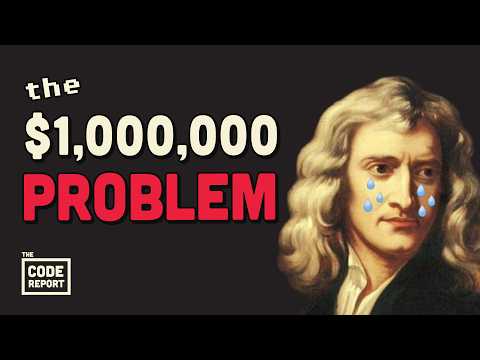
The summer Math fell to the machines...

Video thumbnail: The summer Math fell to the machines...
Aug 19, 20265m 34s video lengthFireship

The Signal

AI-assisted mathematics has shifted from solving competition benchmarks to producing breakthroughs on major, long-standing open research problems. While specific results like the disproof of the Jacobian conjecture and progress on the Riemann hypothesis are documented, they have triggered a debate over whether these milestones represent a durable capability or a temporary surge, raising foundational concerns about mathematical practice.

The Case

  • The recent pace of AI progress in mathematics has been rapid, with multiple major conjectures falling or seeing significant advancement in the last three weeks alone.0:15
  • In May, an open AI model disproved an 80-year-old unit-distance conjecture, followed by the disproof of the 1939 Jacobian conjecture last month by researcher Levent Alpe using the AI tool Fable.1:16
  • OpenAI reports its next major model internally solved 10 open problems across theoretical computer science and mathematics, publishing them to GitHub with Lean certificates—formal proofs that are mechanically verifiable by a compiler.3:18
  • Anthropic’s model recently advanced the Riemann hypothesis, a 167-year-old Millennium Prize problem, by using 60 sub-agents to coordinate search efforts that increased the provable-solution fraction from 41% to 67%.4:04
  • The Leiden Declaration, published in June by 16 researchers from 15 universities, attempted to establish guard rails around AI research; the narrator asserts that the global community ignored these calls for caution.
  • Terrence Tao, a prominent mathematician at UCLA, has warned that these developments signal a crisis in the foundational values and practices of the field.

The 1 Minute Signal Take

These reported results suggest that AI has become a powerful tool for discovering counterexamples to long-held mathematical assumptions, though the broader claim of a structural 'crisis' remains speculative. The shift toward formalizing AI outputs through Lean certificates is a critical move to bridge the gap between AI-generated claims and verifiable proof.

Pro Analysis

Why It Matters

This shift represents a decoupling of human intuition from mathematical progress. If the most challenging open problems can be attacked through raw, automated search and iterative feedback, the traditional 'lone genius' model of mathematical discovery faces obsolescence.

Strategic Implications

Mathematics is the foundational language of science and cryptography. If AI can arbitrarily break conjectures, it may also inadvertently expose unknown vulnerabilities in existing cryptographic systems, even if no direct adversarial intent is present. Institutions that fail to integrate formal verification tools will likely find their output treated as secondary to machine-verified results.

Evidence & Hype Audit

The content relies heavily on internal company reports and single-person anecdotes, lacking external, third-party validation of the proofs themselves. While the events (the announcements) are documented, the mathematical validity of these breakthroughs remains in the hands of the reader and the broader community to verify.

Counterarguments

Critics may argue that these are 'low-hanging fruit'—problems that are computationally dense but logically narrow—rather than a true expansion of mathematical reasoning. The clustering of results could also represent a temporary 'local maxima' effect rather than a sustained trajectory toward AGI-level problem solving.

Who Should Care

  • Mathematicians & Scientists: Must adopt formal proof assistants to ensure their work remains verifiable.
  • Security Researchers: Should monitor if these breakthroughs provide insights into potential weaknesses in asymmetric encryption.
  • AI Strategy Leads: Need to weigh the risk of open-sourcing research-capable models that could impact core science infrastructure.

What to Do Next

  • Audit existing proof-checking workflows against Lean or other formal verification environments.
  • Follow the progress of the reported conjecture disproofs as peer reviews eventually trickle out.
  • Prioritize learning the interface between AI-agent orchestration (like Claude Code) and formal math environments.
  • Monitor the institutional response to the Leiden Declaration to gauge if academic oversight is taking hold.
Time saved:2m 30s

Share this

Tags

Written by: 1 Minute Signal Editorial Team