
Why It Matters
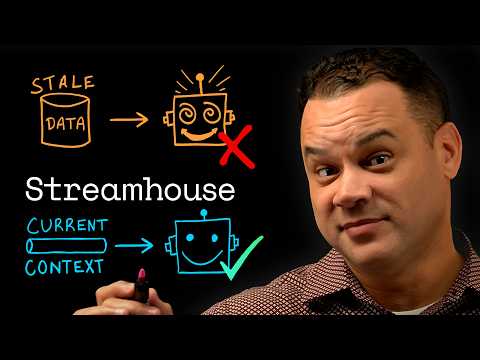
The transition from human-facing analytics to agent-facing decision systems requires a paradigm shift in data reliability. As autonomous agents become the primary consumers of enterprise data, the acceptable latency for 'fresh' data drops from minutes or hours to milliseconds.
Strategic Implications
Organizations currently betting their entire data strategy on batch-processed lakehouses may find themselves unable to integrate sophisticated agentic workflows. Streamhouse represents a shift toward event-driven architectures where the data pipeline itself acts as the source of truth for real-time operations.
Evidence & Hype Audit
This content should be treated as promotional thought leadership rather than an industry standard. While the architectural critique—that batch windows create stale-state hazards—is technically sound, the assertion that an 'industry working group' has standardized Streamhouse lacks specific evidence. The 'best-of-breed' claim regarding Confluent is self-serving and lacks comparative benchmarking data.
Counterarguments
Critics might argue that for most business intelligence tasks, the cost and complexity of implementing a fully decentralized, real-time streaming architecture outweigh the marginal gains in data freshness. Furthermore, existing lakehouse architectures are rapidly integrating streaming features (e.g., incremental processing), which may render the binary choice between 'lakehouse' and 'streamhouse' less relevant.
Role-Specific Takeaways
- Data Architects: Evaluate the cost-benefit of adding a streaming transport layer (e.g., Kafka) to complement existing storage.
- AI Engineers: Stop building retry/validation logic into agent prompts; advocate for governed streams that guarantee data schema and quality at the source.
- CTOs: Beware of vendor lock-in. While the architectural principles are valid, verify that the proposed 'Streamhouse' implementation is vendor-agnostic before committing to a platform.
What To Do Next
- Conduct an inventory of your current 'action-taking' AI agents and identify their data sources.
- Map the 'freshness gap' between your primary operational databases and your agent-accessible data stores.
- Pilot a stream-entry validation process for one high-frequency data feed.
- Evaluate existing streaming tools in your stack that could be repurposed for 'serving' data to AI agents.
- Demand evidence of actual production benchmarks from vendors pitching Streamhouse solutions.