
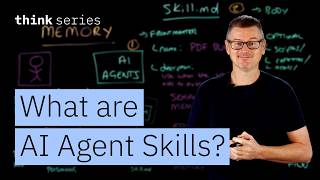

- Procedural memory through skills allows agents to move from answering questions to actively performing work via step-by-step logic.
- The separation of concerns between MCP (external reach), RAG (reference knowledge), and skills (procedural judgment) is critical for modular agent design.
- Skill sharing in open ecosystems mirrors software dependency management and carries similar risks that require strict review of internal script execution.
Channel: IBM Technology
Standardizing Procedural Knowledge for AI Agents via Skills
This video details the emergence of AI agent skills, an open-standard format that provides procedural knowledge to LLMs for executing complex, multi-step workflows. It explains how these skill-based architectures differentiate from retrieval and fine-tuning by enabling autonomous task completion.
Key Takeaways
- Agent skills fill the gap between general reasoning capabilities and specific procedural workflows, effectively replacing the need for repetitive, manual prompting.
- Progressive disclosure ensures efficiency by loading only lightweight metadata at startup and deferring the execution of scripts or heavy instructions until the agent requires them.
- The skill.md open standard allows developers to create portable, version-controlled agents that can move across different platforms without platform-specific configurations.
Talking Points
Analysis
Why This Matters The transition from 'chat-only' LLMs to 'agentic' systems hinges on standardized procedural interfaces. By packag...
Full analysis available on Pro.
Time saved:
Channel: IBM Technology