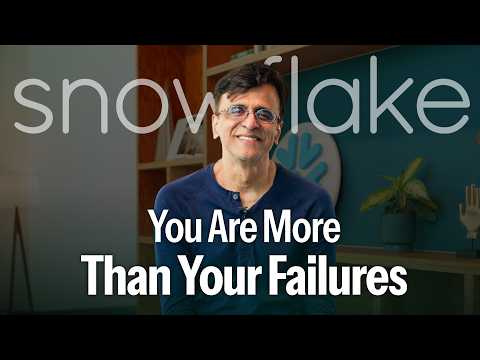
Sridhar Ramaswamy, the CEO of Snowflake, argues that startup success hinges on building products that are objectively 10x better than incumbents, particularly when competing against massive distribution moats. He frames his failed search venture, Neva, as a cautionary lesson in the necessity of product differentiation over merely being 'a little bit better,' while insisting that failure remains a valuable asset for talent and technology transfer.
The Case
Neva, a search startup Ramaswamy founded to challenge Google, failed because its product was only marginally superior to Google's, rather than the 10x improvement required to overcome the incumbent's massive distribution payments to browsers.11:34
Ramaswamy credits Google’s ability to successfully navigate the transition from desktop to mobile ads—a process that took five years of intensive work to achieve monetization parity—as the primary reason the company thrived through the mid-2010s.10:12
He asserts that ChatGPT effectively functions as the successor to Google for information, citing his own troubleshooting of a broken household coffee grinder as evidence that modern AI performs nuanced, practical problem-solving that standard search cannot handle.12:59
Leadership is framed as an act of cultural transmission rather than mere management, where CEOs must act as cultural icons who set standards, nurture talent, and own blame while sharing credit.5:26
The team that developed the AI mode at Neva is currently responsible for building Cortex and Snowflake Intelligence, illustrating his philosophy that failed entities can still function as vital seeds for future enterprise products.15:41
He prioritizes hiring for malleability over expertise, noting that in an AI-integrated economy, high-value skills from yesterday risk being rendered obsolete by new models today.7:11
The 1 Minute Signal Take
This is a candid, grounded assessment of corporate failure and the shifting requirements for product survival in an AI-dominant market. Skip this video unless you specifically need to observe Ramaswamy’s leadership demeanor or his strategic approach to talent retention.
Pro Analysis
Strategic Significance:
The transition from dedicated search products to integrated AI data ecosystems represents a shift in enterprise va...