
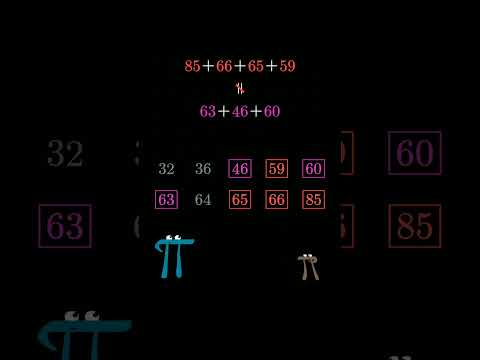
- The challenge of finding two distinct subsets with identical sums is solvable due to the restricted range of possible sums compared to the total number of subsets.
- The game acts as a practical demonstration of how combinatorial constraints force specific outcomes in probability and set theory.
Channel: 3Blue1Brown
The subset sum puzzle
The video presents a combinatorial game theory puzzle involving the existence of distinct subsets with identical sums within a randomly selected set of integers.
Key Takeaways
Talking Points
Analysis
This puzzle is an excellent introduction to the power of the Pigeonhole Principle, a foundational concept in discrete mathematics and theoretical computer science. It is important because it demonstrates how to prove the existence of a configuration without needing to exhaustively search for it.
Who Should Care?
- Software Engineers: This logic is crucial for algorithmic optimization and understanding collisions in hash functions.
- Mathematicians/Students: It demonstrates the beauty of non-constructive proofs.
Non-Obvious Takeaway
While we know a solution must exist, the puzzle does not require an efficient algorithm to find that solution. The strategic insight is recognizing that you don't need to know the specific values to win; the outcome is predetermined by the cardinality of the power set versus the range of sums.
Channel: 3Blue1Brown