
Back to Feed
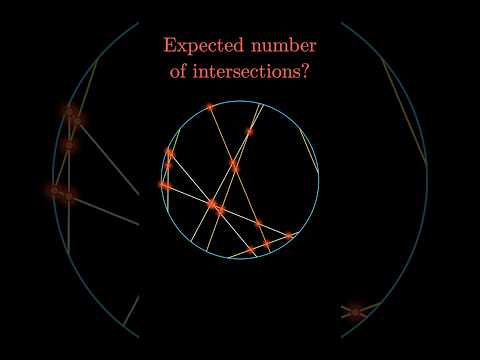
100 random chords, how many intersections?
The Signal
This video introduces a geometric puzzle concerning the expected number of interior intersections among sets of random chords within a circle. To avoid the ambiguity inherent in “random chord” — a concept famously prone to Bertrand’s paradox — the speaker fixes the sampling method to two points chosen uniformly on the circle. The puzzle is presented as part of a multi-month series, though the reason for this grouping remains unstated.
The Case
- To define a “random chord” precisely, the speaker dictates that one point is chosen uniformly on the circle, a second point is chosen the same way, and the two are connected.
- The core challenge is calculating the expected number of interior intersection points for two specific sets: 10 random chords and 100 random chords.
- The speaker invokes Bertrand’s paradox to justify why a specific sampling rule is necessary for the problem to be mathematically well-posed.
- The narrator claims this puzzle is intentionally linked to those from the previous two months, but offers no specific reason or thematic connection within the video segment.
The 1 Minute Signal Take
The video serves as a clear, rigorous setup for a combinatorial problem but offers no solution or explanation for the broader series context. Skip it, as you have the entire problem definition required to pursue the math independently.
Time saved:
Back to Feed