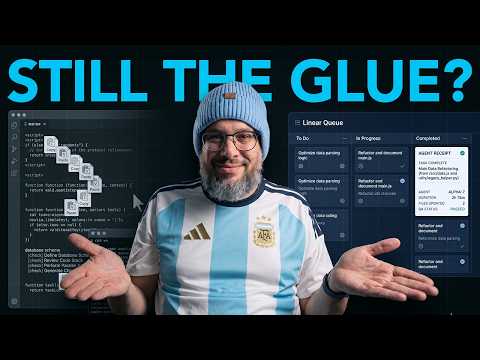
I Built an Open Engine That Connects Claude, ChatGPT, and Codex Together

Video thumbnail: I Built an Open Engine That Connects Claude, ChatGPT, and Codex Together
Jun 26, 202622m 4s video lengthAI News & Strategy Daily | Nate B Jones

The Signal

Multi-agent AI workflows are currently bottlenecked not by model intelligence, but by the "hallway" of invisible human labor required to move context between separate tools. The speaker proposes "Open Engine," a framework using a shared ticketing system like Linear to store state and facilitate delegation between agents, rather than relying on isolated, ephemeral chat logs. While this system is presented as a practical way to manage household and team coordination, the efficacy of this specific integration layer remains a proposal based on the speaker's personal use cases rather than validated industry practice.

The Case

  • The core coordination problem is that humans must manually copy-paste state, receipts, and context between specialized tools like Claude or custom coding agents, creating a repetitive bottleneck.2:10
  • The proposed solution replaces chat windows with a shared ticket queue where agents can read tasks, claim-lock issues, and leave explicit receipts as a formal record of completion.6:34
  • The system requires five components: a ticketing platform (e.g., Linear), as well as dedicated skills for status management, queue processing, agent setup, and smoke-testing protocols.8:49
  • Agents follow a strict protocol of moving issues through defined statuses like "Agent Working" or "Needs Input," which forces the agent to ask specific blocking questions instead of guessing when instructions are ambiguous.15:34
  • The workflow is designed for interoperability; one agent (e.g., a coding tool) can create a ticket in the shared queue which is then claimed and processed by another agent (e.g., a logic tool) without direct API integration.14:21
  • The speaker claims this framework reduces the burden of household and professional tasks, though these assertions are based on his internal experience and lack independent verification.1:04

The 1 Minute Signal Take

The speaker’s thesis on the inadequacy of chat as a state-management layer for autonomous agents is compelling, and the ticketing framework offers a concrete, low-tech way to bring order to heterogeneous AI ecosystems. However, the system introduces significant operational overhead and management discipline; it is essentially a manual process protocol that assumes agents will adhere to strict, queue-based instructions. Watch this video if you want the specific workflow mechanics for building an "Open Engine" queue, but skip it if you are looking for a plug-and-play solution.

Pro Analysis

Strategic Significance

This approach effectively treats AI agents as modular workers rather than singular oracles. By offloading state management from the model's transient memory to a robust ticketing system, it aligns agent technology with mature software engineering project management (PM) patterns.

Who Should Care

  • Engineering and Operations Leads: Those dealing with fragmented AI tool-stacks who need a repeatable, auditable way to manage complex, multi-step workflows.
  • Power Users: Individuals managing complex personal projects who are currently overwhelmed by the manual "handoff" labor between different LLM sessions.

Contrarian Takeaway

Making an agent faster or smarter does nothing to solve the friction of production; in fact, increasing intelligence without a structured handoff layer often accelerates the speed at which you accumulate unmanaged, disorganized work.

Time saved:19m 34s

Share this

Tags