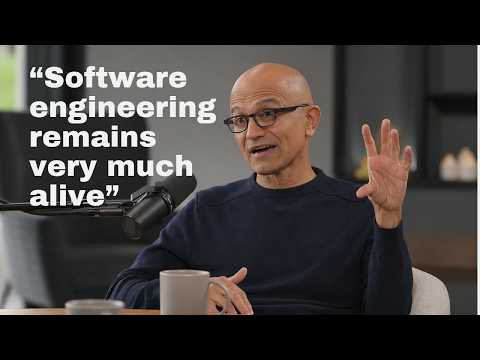
Software engineering after code becomes cheap with Satya Nadella

Video thumbnail: Software engineering after code becomes cheap with Satya Nadella
Nov 16, 20261h 3m 39s video lengthThe Pragmatic Engineer

The Signal

Satya Nadella, CEO of the 51-year-old Microsoft, argues that the proliferation of cheap AI code generation necessitates a structural pivot toward verification, sovereignty, and multi-model enterprise architectures. He frames this transition not as a decline in software engineering, but as an organizational reconfiguration where control, auditability, and operational rigor become the new competitive primitives.

The Case

The Shift to Verification

  • Cheap code generation shifts the engineering burden from writing to verification, as testing and critique loops become the primary bottleneck in software delivery.12:52
  • Brownfield systems—such as Windows, GitHub, and Azure networking—require deep retrofitting of build systems and CI/CD pipelines to accommodate agentic activity and vulnerability patching.22:33
  • Decision engines, which Nadella likens to the "stored procedures" of the intelligence era, are emerging as reusable primitives that encode recurring business logic.10:31

Sovereignty and Architecture

  • Enterprises must treat their AI stack as a sovereign asset by separating the model harness, context, memory, and action space from any specific frontier model.44:39
  • Microsoft’s strategy relies on a multi-model approach, utilizing open models, closed models, and local edge inference, managed through routing platforms like Foundry.
  • Agents must be governed like insider risks, necessitating runtime observability, human-in-the-loop escalation, and audit logs to handle alignment gaps.52:01

Organizational Reconfiguration

  • Microsoft frames voluntary exit offers as providing agency for employees to move into roles better suited to the new "full stack" engineering requirements.31:46
  • The company anticipates a hybrid intelligence future where edge devices, such as the Surface Ultra, act as token factories alongside cloud-based model routing.56:37

The 1 Minute Signal Take

Nadella posits that the era of relying on a single vendor's frontier model is ending in favor of a swappable, control-focused architecture. If the industry follows this blueprint, the primary value for developers will migrate from raw code production to the design of verifiable, observable decision systems.

Pro Analysis

Why It Matters

This discussion marks a departure from the 'AI as a chatbot' paradigm toward 'AI as a core infrastructure primitive.' By framing software engineering as a system-design problem rather than a syntax-writing problem, Nadella provides a blueprint for how massive, legacy-heavy organizations remain competitive in an era of hyper-fast automation.

Strategic Implications

Companies that focus solely on consuming frontier models are at risk of being disintermediated by their own vendors. Microsoft's push into managed model-routing (Foundry) and sovereign infrastructure suggests that the winning enterprise strategy is to be the 'platform of platforms,' rather than a single-model consumer.

Evidence & Hype Audit

This content is highly reflective of a CEO's strategic roadmap. While grounded in Microsoft’s specific internal efforts (Windows CVE pipelines, GitHub internals), it is inherently biased toward Microsoft’s product ecosystem. The claim that IDEs are 'fading away' is arguably premature hyperbole intended to capture the excitement of the current agentic-workflow shift.

Counterarguments

Critics might argue that Nadella’s vision of 'swappable' model architectures is technologically easier to describe than to implement. The friction of migrating between model families—each with unique tokenization, context-window idiosyncrasies, and alignment behaviors—is often high enough to effectively lock customers in regardless of the 'harness' architecture.

Who Should Care

  • CTOs/Platform Engineers: Look for the decoupling of logic from models.
  • Engineering Managers: Focus on re-training teams for verification and test-suite design.
  • Security Architects: Develop runtime observability layers for agentic systems.

What to do next

  • Audit existing CI/CD pipelines to identify where AI-driven verification can replace manual code review.
  • Design an 'evaluation harness' that defines your firm's success criteria independently of any specific model provider.
  • Begin routing high-volume, repetitive tasks toward smaller, local or deterministic engines to lower costs.
  • Establish 'trust checkpoints' for any agentic workflow that interacts with production databases or external networks.
Time saved:1h 31s

Share this

Tags

Written by: 1 Minute Signal Editorial Team