
Why It Matters
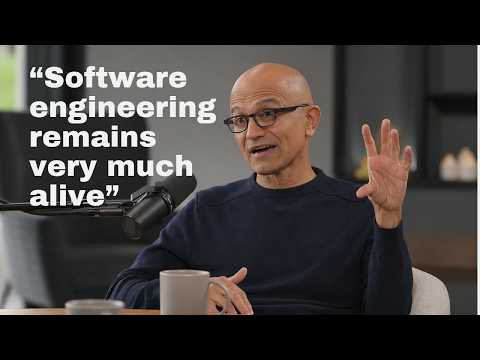
This discussion marks a departure from the 'AI as a chatbot' paradigm toward 'AI as a core infrastructure primitive.' By framing software engineering as a system-design problem rather than a syntax-writing problem, Nadella provides a blueprint for how massive, legacy-heavy organizations remain competitive in an era of hyper-fast automation.
Strategic Implications
Companies that focus solely on consuming frontier models are at risk of being disintermediated by their own vendors. Microsoft's push into managed model-routing (Foundry) and sovereign infrastructure suggests that the winning enterprise strategy is to be the 'platform of platforms,' rather than a single-model consumer.
Evidence & Hype Audit
This content is highly reflective of a CEO's strategic roadmap. While grounded in Microsoft’s specific internal efforts (Windows CVE pipelines, GitHub internals), it is inherently biased toward Microsoft’s product ecosystem. The claim that IDEs are 'fading away' is arguably premature hyperbole intended to capture the excitement of the current agentic-workflow shift.
Counterarguments
Critics might argue that Nadella’s vision of 'swappable' model architectures is technologically easier to describe than to implement. The friction of migrating between model families—each with unique tokenization, context-window idiosyncrasies, and alignment behaviors—is often high enough to effectively lock customers in regardless of the 'harness' architecture.
Who Should Care
- CTOs/Platform Engineers: Look for the decoupling of logic from models.
- Engineering Managers: Focus on re-training teams for verification and test-suite design.
- Security Architects: Develop runtime observability layers for agentic systems.
What to do next
- Audit existing CI/CD pipelines to identify where AI-driven verification can replace manual code review.
- Design an 'evaluation harness' that defines your firm's success criteria independently of any specific model provider.
- Begin routing high-volume, repetitive tasks toward smaller, local or deterministic engines to lower costs.
- Establish 'trust checkpoints' for any agentic workflow that interacts with production databases or external networks.