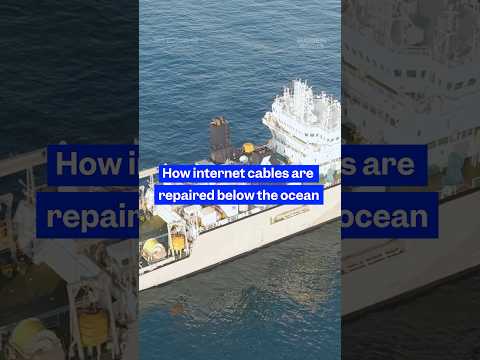
Why a severed undersea #internet cable can cost more than $1 million to repair. #bigbusiness

Video thumbnail: Why a severed undersea #internet cable can cost more than $1 million to repair. #bigbusiness
Oct 28, 20262m 30s video lengthBusiness Insider

The Signal

Undersea cables are the silent backbone of the global internet, yet they are vulnerable to frequent accidental damage and increasingly suspect as targets in geopolitical maneuvering. While cable cuts are a routine infrastructure problem, recent outages have sparked significant alarm; however, despite fears of covert underwater warfare, investigators have yet to confirm any state-sponsored sabotage. The central tension lies in balancing the operational reality of common maritime accidents against the rising strategic necessity of protecting critical digital links.

The Case

The Mechanics of Failure

  • Approximately 100 undersea cables are severed accidentally every year, most commonly by ship anchors dragging along the seafloor.0:06
  • Repairs are a labor-intensive, specialized process involving ROVs to locate the cable, grappling hooks to pull it up, and fusion splicers to reconnect individual fibers at a micron-level of precision.
  • These operations can take weeks to complete and cost more than $1 million, demonstrating that cable maintenance is an expensive and slow-moving technical challenge.

Strategic Consequences and Security

  • The vulnerability of this infrastructure can have devastating national effects, as seen when a 2022 volcanic eruption severed the cable connecting Tonga to the world, leaving the nation without normal internet service for 18 months.0:50
  • As global dependence on AI and cloud computing accelerates, cable resilience has evolved from a technical maintenance issue into a matter of international security.1:43
  • To mitigate risk, countries are increasing naval patrols and testing new defensive technologies, such as the DAS interrogators currently being evaluated in Finland, which turn fiber-optic cables into vibration sensors to detect nearby activity.
  • Although disruptions in regions like the Baltic Sea and Taiwan Strait have heightened fears of foreign sabotage, no recent investigation has proven that a foreign government has ordered such an attack.1:23
  • Infrastructure experts argue that the most effective defense against both accidental and intentional cuts is building network redundancy by laying more cables, ensuring traffic can be rerouted if a single line fails.2:13

The 1 Minute Signal Take

While the fear of undersea sabotage is driving military and security spending, the data suggests that these cables remain primarily at risk from routine maritime accidents. Building greater physical redundancy is likely a more effective strategy for national resilience than focusing on unproven attribution claims.

Pro Analysis

Why it matters

The security of undersea cables represents a critical blind spot in modern infrastructure. As we push more of the global economy into the cloud, the physical fragility of the internet becomes a significant bottleneck. This content effectively bridges the gap between routine maintenance and geopolitical instability, highlighting how a mundane accident can quickly spiral into a crisis of national security.

Strategic implications

The shift toward "active defense"—using cables as sensors via DAS interrogators—suggests that the industry is moving away from passive burial toward active monitoring. For organizations, this implies that service-level agreements (SLAs) regarding uptime may become increasingly tied to the geopolitical stability of the undersea routes their data traverses.

Evidence & Hype Audit

The content is highly trustworthy because it maintains a rigorous boundary between observed technical reality (repair processes, frequency of cuts) and speculative geopolitical fear. It avoids the temptation to declare a 'war in the deep,' instead explicitly noting that evidence of state-sponsored sabotage is lacking.

Counterarguments / Contrarian view

One could argue that the focus on 'covert warfare' is a distraction from the more prosaic, yet equally damaging, threat of commercial shipping negligence. Over-securitizing these lines might lead to geopolitical tensions that outweigh the actual benefits of increased military presence on the seabed.

Who should care

  • Telecom Infrastructure Planners: Must weigh the high cost of redundancy against the massive operational and reputation risk of long-term outages.
  • National Security Officials: Must decide how much of the defense budget should be diverted to maritime patrolling and sensor deployment for non-military infrastructure.
  • Cloud/AI Architects: Should be auditing their network pathing to ensure their traffic doesn't rely on singular, vulnerable underwater bottlenecks.

What to do next

  • Audit existing network paths to ensure true geographic diversity in data routing.
  • Evaluate the business continuity plan for 18-month outages, not just 18-hour ones.
  • Monitor advancements in fiber-sensing technology for potential integration into private dark-fiber networks.
  • Support international efforts to standardize maritime navigation regulations near critical cable hubs.

Share this

Tags

Written by: 1 Minute Signal Editorial Team