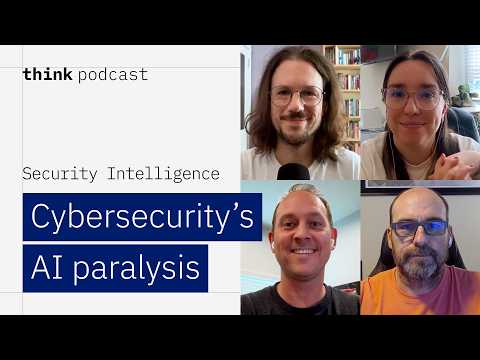
What should security leaders do with AI? They don’t know.

Video thumbnail: What should security leaders do with AI? They don’t know.
Aug 19, 202629m 15s video lengthIBM Technology

The Signal

Security leaders report widespread decision paralysis regarding AI adoption, driven by uncertainty, high procurement costs, and the fear of expensive mistakes. While attacks leveraging AI have jumped 56% year-over-year, the current consensus is that AI maturity remains low—comparable to a student in the third grade rather than an expert—suggesting organizations should prioritize bounded, low-risk starting points rather than broad, autonomous deployment.

The Case

Strategic Adoption

  • Security teams are struggling to translate budget and intent into action, with 64% of organizations currently reporting little to no AI integration in their security functions.1:30
  • The panel recommends starting with red-team threat emulation to better understand attacker behavior and low-risk, repetitive tasks like alert triage, vendor risk assessments, and contract analysis to reduce operational fatigue.0:08
  • To maintain agility in a volatile environment, leadership advises shifting away from standard 3–5 year vendor contracts toward 1–2 year agreements with option years to preserve the ability to fail fast without excessive commitment.5:49

Emerging Risks

  • Researchers have identified "ghost jacking," a sophisticated prompt injection where attackers embed malicious instructions into trusted artifacts like logs or error reports, successfully compromising agents even after the initial attack request is blocked by a firewall.10:56
  • AI-generated patching remains unreliable; a study of 540 patches across 6 vulnerabilities found only 46% effectively solved the issue, with successful patches often introducing new defects, confirming that human oversight is still required for code changes.21:10
  • Panelists emphasize that agentic security is fundamentally a permissions and governance challenge, advocating for strict limits on what agents can do and requiring human validation for high-risk actions like privilege escalation.18:33

The 1 Minute Signal Take

AI is currently an assistive, early-stage technology that requires strict boundary-setting, not a mature replacement for human security judgment. Success hinges on shifting from long-term, high-stakes bets to narrow, high-frequency tasks where failures are containable and human-in-the-loop validation is built into the workflow.

Pro Analysis

Strategic Implications

The shift toward 'agentic' security models necessitates a radical rethink of trust boundaries. When AI agents con...
Full analysis always available on Pro.

Time saved:27m 32s

Share this

Tags

Written by: 1 Minute Signal Editorial Team