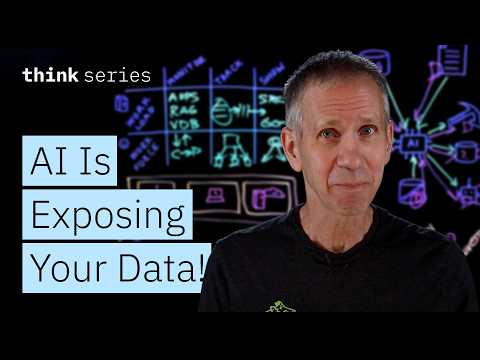
AI Is Exposing Your Data: An AI Security Problem You Can't See

Video thumbnail: AI Is Exposing Your Data: An AI Security Problem You Can't See
Sep 27, 202611m 29s video lengthIBM Technology

The Signal

AI integration is creating decentralized data-exposure risks that traditional security tools fail to catch. Because data is continuously transformed through prompts, RAG (retrieval-augmented generation), and agents, organizations can no longer rely on static monitoring. The core tension lies between the rapid speed of AI adoption and the difficulty of maintaining visibility across hidden paths.

The Case

  • AI data exposure occurs through multiple concurrent channels, including shadow AI—unauthorized internal projects—and public chatbots where sensitive data may be used to train external models.0:32
  • Traditional Data Loss Prevention (DLP) tools are often insufficient because sensitive data changes form as it moves through vector databases, agents, and RAG pipelines, rendering exact-string matching ineffective.1:29
  • Effective oversight requires tracking lineage from the original source through each transformation to the final endpoint, rather than simply monitoring which AI tools are active. ### Integrated Discovery7:09
  • Agentic platform discovery, endpoint DLP, and cloud-based monitoring each capture only partial data, necessitating a unified platform to provide a single view of risk.9:07
  • Organizations must move toward proactive, context-aware investigation, with the stated operational goal of reducing response times from weeks to minutes.
  • Governance must extend to meeting compliance requirements for GDPR, the EU AI Act, SOC 2, ISO 27001, and HIPAA to account for the movement of PII (personally identifiable information) and intellectual property.10:39

The 1 Minute Signal Take

Organizations must shift from static tool-based monitoring to a lineage-driven approach that tracks data transformation across both AI workloads and workforce usage. Whether existing tools can be integrated or a dedicated AI-governance platform is necessary remains the central, unresolved strategic question for security teams.

Pro Analysis

Why It Matters

As enterprises scale their reliance on generative AI, the security perimeter is effectively dissolving. If sensitive data cannot be traced through autonomous agents and RAG systems, corporations risk severe regulatory penalties and catastrophic IP loss. This content highlights the shift from perimeter defense to data-lineage defense.

Strategic Implications

Organizations that attempt to solve this via point-solutions or siloed endpoint security will likely remain vulnerable to shadow AI. Moving to an integrated lineage model represents a fundamental change in security architecture: it requires shifting from 'what tool is being used' to 'how is data moving through the system.'

Evidence & Hype Audit

This content is clearly structured as a vendor-led argument. While the technological claims regarding the difficulty of tracing data through vector databases and agents are accurate, the video relies on alarmist, unsourced metrics like the '31% violation' figure. It treats 'public chatbot' usage as an binary danger without acknowledging potential enterprise-grade data privacy agreements.

Counterarguments

Critics might argue that a 'unified visibility platform' introduces excessive latency and administrative complexity. Furthermore, many existing endpoint-based DLP tools are rapidly adding AI-aware context, potentially closing the visibility gap without requiring an entirely new platform.

Who Should Care

  • CISOs/Security Architects: Must evaluate if current DLP tools can track data transformations.
  • Data Privacy Officers: Responsible for mapping AI-based data flows to compliance requirements.
  • IT Managers: Need to detect and neutralize 'Shadow AI' usage before it breaches sensitive silos.

What To Do Next

  • Conduct a shadow IT audit specifically targeting unauthorized AI agents and browser extensions.
  • Map all data entry points into your RAG pipelines and vector databases.
  • Evaluate existing DLP tools for their ability to perform cross-workload lineage tracking.
  • Update incident response playbooks to include AI-specific data breach scenarios.
  • Establish continuous discovery protocols for new AI tool adoption.
Time saved:8m 33s

Share this

Tags

Written by: 1 Minute Signal Editorial Team