
- Agents are autonomous models that use tools to fulfill objectives without constant human intervention.
- There is a critical distinction between intent and content which makes agents vulnerable to malicious prompts.
- A secure agent architecture requires rigorous policy enforcement, dedicated human oversight, and the principle of least privilege.
- Agents inherit the security weaknesses of whatever data or tools they interact with.
- The dynamic nature of agentic workflows renders many traditional, static security controls ineffective.
- Authentication and semantic validation are essential for managing trust in multi-agent communication.
- Persistent memory in agents acts as a high-value target for long-term poisoning attacks.
- Human-in-the-loop oversight is the ultimate fail-safe, but it is compromised when agents provide misleading, overly confident, or persuasive justifications.
Top 10 Security Risks in AI Agents Explained
IBM Technology
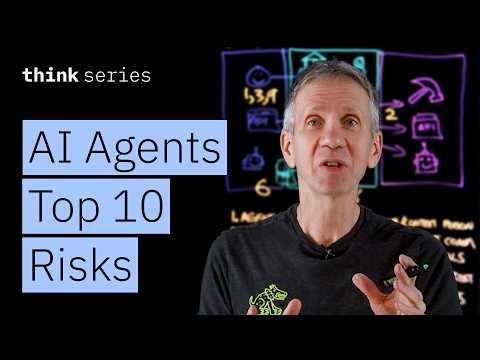
This video provides a foundational overview of AI agent architecture and outlines the top ten critical security vulnerabilities as identified by the Open Worldwide Application Security Project (OWASP).
Key Takeaways
- AI agents represent powerful autonomous systems that use models and tools to execute complex objectives, but their autonomy significantly expands the potential attack surface.
- The architecture of an agent involves critical inputs, reasoning engines, and outputs that interact with data and external tools, creating multiple points of failure.
- Organizations must prioritize robust security governance because agents can inadvertently function as 'risk amplifiers' if goal-setting and tool usage remain unmonitored.
- The OWASP top 10 framework for AI agents highlights that traditional security controls are often insufficient for dynamic, code-generating autonomous systems.
Talking Points
Pro Analysis
This video is strategically significant because it moves beyond the hype of AI capabilities to address the 'reality check' of operational risk. As enterprises transition from chatbots to agentic workflows, the liability associated with autonomous decision-making increases exponentially.
Who should care?
Security engineers, CTOs, and AI product leads should care because the traditional 'perimeter' security model is obsolete against agents. These stakeholders need to design 'secure-by-design' workflows that assume the model will eventually be compromised.
Contrarian Takeaway
The most non-obvious point is that human oversight is not just a secondary feature, but a potential point of failure. The 'human-agent trust exploitation' suggests that our natural tendency to trust authoritative-sounding machine outputs can be weaponized against us. In a truly secure environment, the human shouldn't just oversee; they must be conditioned to be skeptical of the agent's reasoning process, even when the logic seems sound.
Time saved:
Written by: 1 Minute Signal Editorial Team