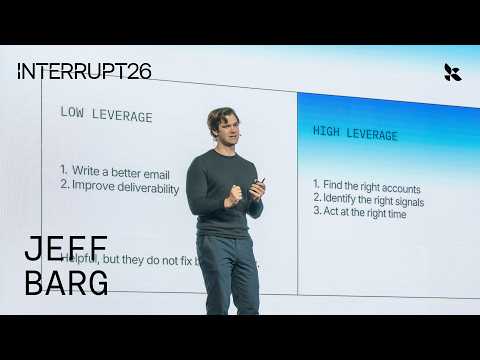
How Clay runs 350 million GTM agents a month | Interrupt 26

Video thumbnail: How Clay runs 350 million GTM agents a month | Interrupt 26
Jun 24, 202611m 54s video lengthLangChain

The Signal

Jeff Barg, head of AI at the GTM platform Clay, argues that enduring competitive advantage in go-to-market (GTM) is no longer a matter of superior copywriting, but of treating GTM as an engineering-scale optimization problem. The core tension lies in shifting from individualized AI usage to automated, market-wide agent orchestration that relies on proprietary data and iterative feedback loops.

The Case

Scaling Operations and Infrastructure

  • Barg claims Clay runs over 350 million GTM agents monthly, utilizing a proprietary dataset of 40 million companies and 900 million contacts to score timing and targeting across entire addressable markets.0:48
  • Clay moved its primary agent execution from Lambda to ECS to avoid prohibitively expensive wall-time billing, trading serverless convenience for durable, resumable workflow execution.5:43
  • The company implemented a TCP-like adaptive back-pressure system to manage throughput under rate limits, which internal experiments suggest increases performance by 4–10x compared to naive systems.6:46
  • Caching represents a significant cost lever, with Barg citing up to 70% savings when implemented for providers such as Anthropic, provided the agents are designed with caching logic in mind.7:44

Quality and Intelligence

  • Quality is framed not just as model output, but as a product design challenge; Clay developed an "Audiences" layer that aggregates data from Snowflake, Salesforce, Gong, and news signals to serve as the memory and context layer for agents.10:06
  • Barg argues that the best customers use a flywheel effect: scanning the market, scoring timing, executing plays, and learning from outcomes to systematically improve future targeting.3:52
  • Optimization is gated by the ability to run offline and online evaluations, with Barg recommending that users utilize agent-building tools to test iterations before deploying at scale.8:57

The 1 Minute Signal Take

The primary takeaway is that scaling AI-driven GTM requires moving away from simple prompt-based automation toward robust, observable, and data-contextualized infrastructure. While Clay’s specific performance claims are internally reported, the shift toward treating agent throughput, cost, and reliability as a unified engineering loop is the necessary frontier for high-volume sales execution.

Pro Analysis

Why It Matters

Clay provides a blueprint for the second generation of AI applications. While the industry spent the last two years hyper-focusing on prompt engineering and model quality, Clay highlights a market shift toward the infrastructure of execution. This is where AI moves from 'feature' to 'force multiplier' in enterprise environments.

Strategic Implications

  1. The Death of Generic Outbound: If targeted, signal-based agents becomes the standard, standard 'spray-and-pray' email tools will see their ROI approach zero.
  2. Engineering vs. Marketing: The GTM department is becoming a data-engineering department. Teams that fail to align their CRM data to the requirements of agent 'memory' will be left behind.

Evidence & Hype Audit

  • Trustworthy Aspects: The operational constraints described (wall-time billing, rate limits, infrastructure migration) are grounded in standard cloud-native engineering realities.
  • Hype Risks: The claims of '4-10x throughput' and '70% cost savings' are internal results without third-party replication. These should be viewed as best-case scenario outcomes specific to Clay’s highly optimized workload.

Counterarguments

Critics might argue that intense data centralization (the 'Audiences' layer) creates significant privacy and data-leakage risks, especially when aggregating sensitive call recordings and internal CRM data alongside third-party AI agents.

What To Do Next

  • Audit your current agent workflows for 'idle waiting' to identify potential serverless cost sinks.
  • Implement a circuit-breaker or back-pressure logic for any agent that calls external APIs.
  • Evaluate the current data accessibility of your CRM (Snowflake/Salesforce)—are your agents actually using this, or just hallucinations in a vacuum?
  • Start measuring 'Agent ROI' by tracking conversion outcomes rather than just total email volume.
Time saved:8m 51s

Share this

Tags