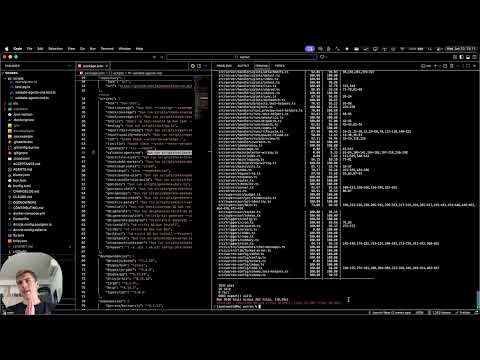
Agents Are An Environment Problem

Video thumbnail: Agents Are An Environment Problem
Jun 11, 202613m 14s video lengthJaymin West

The Signal

Autonomous software agents are currently treated by many as unreliable interns that require heavy documentation, but the creator argues they should instead be managed as an environment problem. By encoding standards directly into deterministic verification suites and commit hooks, he demonstrates that agents can self-correct and ship code autonomously without human oversight. Whether this environment-first approach can reliably guarantee error-free code across all domains, or is merely a well-instrumented workflow for specific project types, remains an open question.

The Case

  • The codebase utilizes a centralized verification suite, "bun check all," which mandates strict typing, linting, test-coverage floors, and file-size constraints before any commit can be pushed to GitHub.3:13
  • A nightly autonomous agent program, dubbed "Night Watch," is shown running at 2:00 a.m. to identify small bugs, decompose tasks, and dispatch fixes that are automatically merged into the main branch.0:43
  • To prevent regressions, the system employs a ratcheting test-coverage floor, currently set at 90.32% with a target of 91.78%, ensuring agents cannot push code that lowers the existing quality baseline.6:03
  • A commit hook serves as the primary enforcement gate; it halts the commit process and forces the agent to resolve failures if the code violates any pre-established repository standards.9:30
  • The creator uses a duplicate-code detection library to identify redundant logic in 30 instances, instructing agents to reuse shared functions instead of generating new implementation fragments.7:24
  • By maintaining local environment checks that mirror CI-parity, the system aims to ensure that any code passing local verification will pass the final integration checks every time, a claim that is ambitious and assumes the environment is perfectly synchronized.8:23

The 1 Minute Signal Take

This video succeeds as a high-trust demonstration of a technical workflow, moving past speculative AI hype into practical, hard-gated engineering. Watch it if you want to see a concrete implementation of autonomous commit-gating that prioritizes system-level constraints over agent-level judgment; skip it if you are looking for a proof that this model effectively eliminates all semantic bugs or is universally transferable to complex legacy applications.

Pro Analysis

Strategic Significance

This approach signals a move toward "hardened" AI-driven development. By transforming the environment into a constraint-driven system, software quality becomes a function of engineering discipline rather than agent capability.

Who Should Care

Engineering leads, DevOps engineers, and solo builders managing multiple repositories. Anyone tired of "correcting" AI mistakes and looking to build a system that scales autonomy without manual oversight.

Contrarian Takeaway

Documentation is largely irrelevant for agent performance. If your process relies on the agent reading a "how-to" guide instead of a failing test suite, you are failing the agent, not vice versa.

Time saved:11m

Share this

Tags

Written by: 1 Minute Signal Editorial Team