I Love the Karpathy LLM Wiki but it Doesn't Scale. Here's What Does.

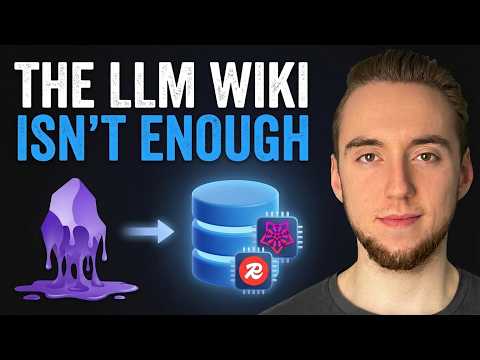
Video thumbnail: I Love the Karpathy LLM Wiki but it Doesn't Scale. Here's What Does.
Jul 9, 202618m 57s video lengthCole Medin

The Signal

Local, markdown-driven agents—the "second brains" familiar to personal-computing enthusiasts—do not scale to production environments. Once multiple users, business-critical data, and governance requirements enter the mix, agents necessitate a shift toward database-backed architectures. This transition trades simple, file-based flexibility for reliable context retrieval and structured memory management.

The Case

Architectural Shift

  • Personal agents built on markdown files excel in individual workflows because they are flexible and local but fail in production due to token-heavy retrieval costs, lack of access control, and inefficient file management as data volume grows.0:42
  • Production-level agents demand a dedicated database layer for scalable search, data-auditing, and role-based governance.2:18

The Demo Architecture

  • The video utilizes Redis Iris, a preview platform that acts as a wrapper over the Redis database to provide a dual-layer approach for production agents: a context retriever and long-term memory management.
  • The context retriever maps unstructured business data to defined entities and auto-generates Model Context Protocol (MCP) tools, enabling the agent to execute surgical queries—such as fetching specific delayed orders—without reading entire documentation sets.5:10
  • Agent memory functions through a two-tier system: short-term session storage captures the interaction, while a background process promotes salient "golden nuggets"—like a specific user's preference for reshipments over refunds—into long-term, vector-searchable storage.

Claims and Caveats

  • The speaker asserts that production agents should avoid markdown-based knowledge bases in favor of structured data, though this represents a tactical recommendation rather than a fundamental technical impossibility.3:52
  • Endorsements of specific tools, such as the Pydantic AI framework and the Redis Iris platform, are embedded within a sponsored collaboration; the speaker provides no comparative benchmarks to support claims that competing SDKs are categorically slower or more token-inefficient.6:43

The 1 Minute Signal Take

Designing agents for production requires abandoning file-based simplicity for structured database retrieval and automated memory promotion. While this adds infrastructure complexity, it is the necessary tradeoff to move from local, personal automation to reliable, multi-user business systems.

Pro Analysis

Why It Matters

This presentation highlights the critical 'chasm' in current LLM development: the gap between a high-utility local agent ...
Full analysis always available on Pro.

Time saved:17m 12s

Share this

Tags