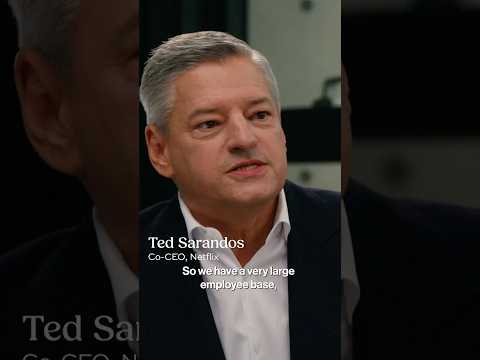
Ted Sarandos on Netflix Job Cuts, Leadership Shakeup

Video thumbnail: Ted Sarandos on Netflix Job Cuts, Leadership Shakeup
Nov 18, 20262m 11s video lengthBloomberg Originals

The Signal

Netflix is navigating a period of organizational realignment and leadership turnover, with co-CEO leadership acknowledging that while the business is functioning globally, US performance has fallen short of internal targets. The executive frames these shifts as necessary preparations for the company's next stage, though the specific rationale and metrics for these changes remain unstated. The company is doubling down on ambitious storytelling as its primary competitive differentiator against fleeting social media content.

The Case

Leadership and Accountability

  • The executive identifies himself and his co-CEO, Greg, as ultimately responsible for all company outcomes, including recent organizational shifts.1:29
  • The departures of leaders Bella and Dan are presented not as a rejection of their past success, but as a judgment that their skill sets may not align with the next stage of Netflix’s business maturity.0:41

Performance and Strategy

  • Netflix management identifies the US as a market where performance needs to improve, even while claiming the business is currently working effectively worldwide.1:09
  • The company plans to compete by prioritizing "ambitious storytelling" over content designed for brief engagement, predicting that content abundance driven by AI will only increase viewer demand for high-quality narratives.

Organizational Context

  • The executive describes the recent employee adjustments as a broad realignment across many groups, asserting that such events are rare and that the last comparable shift occurred approximately five years ago.0:06
  • While the executive expresses sympathy for affected staff, he provides no concrete headcount, performance metrics, or specific decision-making criteria behind the timing of these adjustments.

The 1 Minute Signal Take

The executive’s narrative prioritizes forward-looking justification over retrospective detail, leaving the actual scale of these adjustments and the specific reasons for the US performance gap opaque. Readers should interpret these statements as strategic signaling from management rather than a transparent report of operational reality.

Pro Analysis

Strategic Implications

The transition from an expansion-focused firm to an efficiency-and-quality-focused organization is the defining narrative for Netflix. By linking organizational changes to 'future-stage fit,' Sarandos is setting the stage for a leaner, more selective leadership culture. This move suggests that the 'growth at all costs' era is being replaced by a 'hit rate' optimization strategy, where even high-performing leaders are expendable if their expertise doesn't map to the next tactical requirement.

Evidence & Hype Audit

This content is high-level corporate messaging. There is a notable lack of quantitative evidence—'hit rate' is never defined, and the scale of the job cuts is kept vague. The assertion that this makes the company 'healthier' is a subjective claim from an interested party. Skeptics should view these comments as a public-relations effort to frame internal turbulence as a calculated evolution.

Counterarguments

One could argue that 'future-stage fit' is simply a convenient euphemism for replacing expensive, long-term talent with more compliant or cost-effective management. Additionally, the belief that AI will drive audiences toward 'ambitious' stories might be wishful thinking; if AI creates highly personalized, engaging content, it could paradoxically make 'ambitious' stories seem slow or inaccessible to mainstream users.

Who Should Care

  • Investors: Monitor if the 'hit rate' improvement actually manifests in US subscriber retention.
  • Netflix Employees: Prepare for a culture that prioritizes specialized, forward-looking skills over general seniority.
  • Competitors: Watch if this 'ambitious storytelling' focus creates a market opening for lower-cost, high-frequency engagement content.

What to Do Next

  • Define the specific internal metrics being used to measure the current 'hit rate.'
  • Track the turnover rate of senior leadership over the next 12 months as a proxy for the 'future-fit' mandate.
  • Assess if content production costs decrease as the company pivots toward 'ambitious' (and potentially fewer) projects.
  • Evaluate the performance of recent US-centric content releases against the executive's admitted 'should be doing better' benchmark.

Share this

Written by: 1 Minute Signal Editorial Team