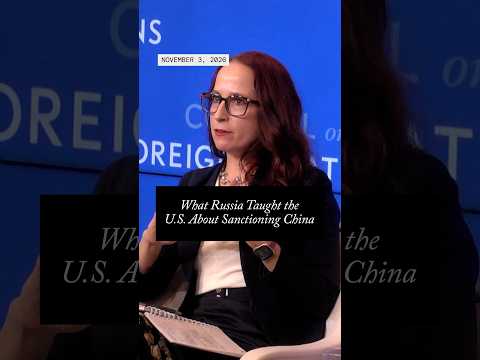
What Russia Taught the U.S. About Sanctioning China

Video thumbnail: What Russia Taught the U.S. About Sanctioning China
Nov 16, 20261m 28s video lengthCouncil on Foreign Relations

The Signal

Strategic thinkers argue that the hesitant approach to Russian sanctions—driven by fears of inflation and energy dependence—prolonged the ongoing conflict into 2026. This history serves as a cautionary precedent for how to handle China, where deep integration into global financial markets creates a far more dangerous environment for economic coercion than Russia ever did.

The Case

The Russia Precedent

  • Policymakers kept sanctions on Russia relatively light because the country was a vital carbon exporter and officials feared triggering disastrous inflation by cutting off energy supplies.
  • The speaker asserts that this restraint was a tactical error, arguing that had economic pressure been applied more aggressively, the current conflict would not still be ongoing.0:00
  • A counterfactual scenario suggests that in a disinflationary, 2008-like macro environment, the U.S. and its allies would have possessed the necessary leverage to lock down Russian energy markets and potentially force a different conflict outcome.0:20

The China Constraint

  • Future coercion strategies must be more aggressive than those used against Russia to avoid the same pitfalls of prolonged engagement.
  • China presents a significantly higher risk because its large financial institutions are GSIBs—Global Systemically Important Banks—meaning they are deeply embedded in the global financial infrastructure.1:03
  • The primary policy dilemma is balancing the need to selectively sever China’s essential infrastructure with the urgent requirement to prevent a global financial system collapse.

The 1 Minute Signal Take

The core takeaway is that while the current strategy of cautious, calibrated sanctions is viewed by some as having failed in the Russian theater, the financial interconnectedness of China makes a 'harder' approach inherently unstable. Policymakers are left in a high-stakes search for new tools that can exert enough pressure to impact conflict outcomes without accidentally detonating the global financial system.

Pro Analysis

Why It Matters

This discourse represents a fundamental shift in how the U.S. views economic warfare. It moves from seeing sanctions as a 'magic bullet' to recognizing them as a high-stakes lever that requires precise calibration based on an adversary's specific role in global capital and energy flows.

Strategic Implications

The shift toward 'surgical' sanctions implies a need for deeper intelligence and real-time financial tracking. Policymakers must map how specific entities serve as conduits for the global economy to avoid collateral damage to their own financial systems.

Evidence & Hype Audit

The content leans heavily on the speaker's personal interpretation of historical cause-and-effect. While the categorization of GSIBs is factual, the causal link between 'lighter' energy sanctions and the duration of the conflict is a subjective, albeit popular, opinion. There is no hard data presented to back the counterfactual 2008 scenario.

Counterarguments

Critics might argue that even 'light' sanctions have long-term structural impacts that take years to manifest, and that the risk of a financial crash from aggressive action against China might be overstated by those who fear the domestic consequences of a decoupling.

Who Should Care

  • Financial Analysts: To assess the risk of systemic contagion from geopolitical events.
  • Policy Wonks: For insight into the changing doctrine of 'creative' economic warfare.
  • Investors: To understand the potential for sudden, targeted disruptions in global supply and financial rails.

What To Do Next

  • Monitor statements from central banks regarding cross-border financial exposure.
  • Track the development of alternative payment infrastructures that bypass traditional GSIB networks.
  • Analyze the specific 'essential infrastructure' sectors that governments identify as high-leverage targets.
  • Diversify portfolios against the risk of rapid, politically-driven financial decoupling.

Share this

Tags

Written by: 1 Minute Signal Editorial Team