
Channel: Brookings Institution
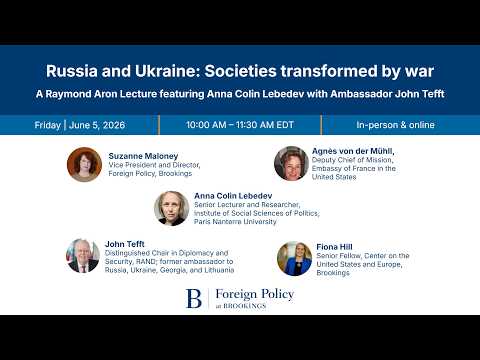
Russia and Ukraine: Societies transformed by war
The Signal
The Russia-Ukraine war has reshaped both nations by exploiting their distinct social histories rather than simply acting as a conventional territorial dispute. Anna Colin Lebedev, a political sociologist, argues that Ukraine’s wartime strength derives from a proactive, bottom-up adaptation by civil society, while Russia’s stability relies on a social contract of 'loyal alienation' that keeps the war invisible to most citizens. Whether this conflict should be understood through regime types or deeper historical structures—and how that framing impacts potential peace settlements—remains a core point of contention among scholars and diplomats.
The Case
- Ukraine’s resilience is rooted in a unique 'art of adaptation' where civil society and military innovation fuse to solve problems; as proof, a private software company built the national air-alert app in just 72 hours after the 2022 invasion.
- Russian society exhibits 'loyal alienation,' where citizens publicly support the state while remaining internally distant; researchers observed residents in Kursk Oblast treating the war’s arrival as a weather condition rather than a political event they could influence.
- Post-2014 Ukrainian identity shifted from deep institutional distrust to 'critical appropriation,' where citizens pressure and assist the state as a core duty of citizenship, while Russian society remains characterized by enforced political apathy.
- The Kremlin’s 2021 historical-unity narrative is framed by Lebedev as a structural denial of Ukrainian distinctness, which stems from a long-standing failure of Russian society to recognize the autonomy of its former peripheries.
- The war risks narrowing the Ukrainian historical horizon, as Lebedev notes that the elevation of nationalist symbols—such as the recent reburial of Andriy Melnyk—threatens to flatten the country's complex WWII-era history into an overly simplistic nationalist myth.
- Former U.S. Ambassador John Teft confirms that Western diplomatic and media misunderstanding of Ukraine was acute before 2022, largely because observers viewed the region through a Russia-centric lens that masked Ukrainian civil society's growth.
The 1 Minute Signal Take
This lecture provides a necessary framework for de-centering Russia in our analysis of the region, moving past state-level power dynamics to explain why these two countries reacted so differently to a shared crisis. While the speaker’s colonial-war analogy remains an academic proposition rather than a solved policy strategy, the evidence for her structural analysis of civil society is compelling and distinct. Watch this if you want to understand the sociological foundations of the battlefield, but you can skip the introduction and ceremonial remarks to get straight to the comparative analysis.
Time saved:
Tags
Channel: Brookings Institution