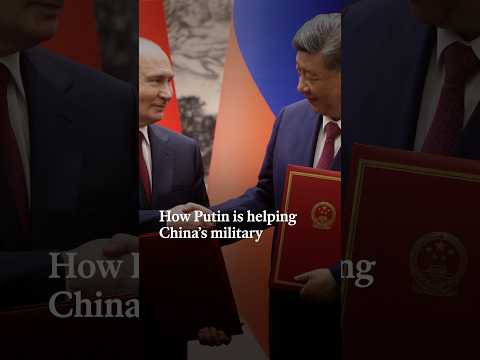
How is Vladimir Putin helping China’s military? | The Economist

Video thumbnail: How is Vladimir Putin helping China’s military? | The Economist
Aug 17, 20262m 53s video lengthThe Economist

The Signal

Evidence suggests that China is using the ongoing war in Ukraine as a live-fire laboratory to modernize its military, with intelligence indicating Russia is facilitating this learning through technical assistance and training. This cross-domain collaboration threatens to significantly alter the strategic balance in Asia, particularly regarding a future Taiwan conflict, as China seeks to bridge its own four-decade combat-experience gap.

The Case

Operational Evidence

  • European intelligence agencies report that a military training complex near Volgograd has hosted Chinese soldiers for instruction in land combat and aerial-drone operations.0:04
  • While Beijing formally denies sending personnel, the ongoing supply of the majority of Russia's military drones gives China direct access to battlefield performance data, allowing for rapid tactical refinement.0:59

Strategic Collaboration

  • Formal military integration is well-documented, beginning with a 2019 Putin-announced early-warning system and reinforced by a 2025 Pentagon report detailing continued Russian support for Chinese ballistic-missile defense.2:01
  • Russia appears to be assisting China in developing stealthier nuclear-powered submarines, though analysts assess that Moscow is unlikely to share its most sensitive design secrets, such as the quiet Yasen-class technology.

The Strategic Stakes

  • The transcript identifies drone warfare, naval counter-drone tactics, and missile defense as the core pillars where Russian experience could provide China a decisive edge.
  • Although claims of large-scale technology transfers remain inferential and partially hedged, the deepening defense alignment suggests a sustained effort to counter Western influence in the Pacific.2:38

The 1 Minute Signal Take

The core issue is that China is methodically harvesting the lessons of the Ukraine war to prepare for a different theater, turning Russia into a strategic tutor. Even if Russia struggles on the battlefield, the institutionalized transfer of military expertise remains a significant, documented shift in the global security environment.

Pro Analysis

Strategic Implications

The cooperation between Moscow and Beijing signals a transition from diplomatic alignment to operational integration. By acting as a technical consultant for the PLA, Russia is helping China compress its 'learning curve' regarding modern electronic and asymmetric warfare. This suggests that the next generation of Chinese military hardware will be informed by the lessons learned from Russia's struggles in Ukraine, effectively allowing China to profit from Russia's losses.

Evidence & Hype Audit

This report is high-signal but relies on a mix of confirmed public announcements (e.g., the 2019 early-warning pact) and intelligence-backed assertions (e.g., soldier presence in Volgograd). The analysis is prudent in differentiating between confirmed strategic support and inferred design transfers. The narrative risk is that it may over-index on the predictive impact regarding Taiwan, which remains speculative.

Counterarguments

One could argue that the relationship is inherently fragile. Russia’s economic dependence on China may force it to trade away more technology than it would prefer, while China may eventually conclude that Russia’s aging Soviet-era knowledge base is diminishing in value. Furthermore, China's distinct military culture and different geopolitical priorities may make the direct application of Russian tactics less effective than assumed.

Who Should Care

  • Defense Analysts: Monitoring the integration of drone performance data into PLA doctrines.
  • Geopolitical Risk Managers: Watching for changes in the regional military balance around the South China Sea.
  • Policy Makers: Tracking the evolution of US-China-Russia defense technology sanctions.

What to Do Next

  • Verify reports of joint research centers focused on early-warning radar arrays.
  • Analyze the evolution of Chinese maritime drone technology to check for similarities to observed Russian countermeasures.
  • Assess whether increased PLA involvement in joint drills leads to substantive changes in regional naval posture.
  • Monitor trade data for components that indicate dual-use technology flows disguised as commercial drone exports.

Share this

Tags

Written by: 1 Minute Signal Editorial Team