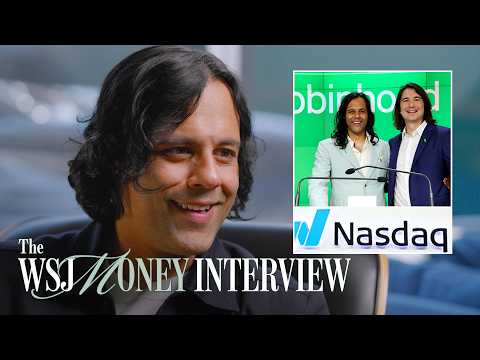
Robinhood Co-Founder Opens Up About Losing $1B in Months | The WSJ Money Interview

Video thumbnail: Robinhood Co-Founder Opens Up About Losing $1B in Months | The WSJ Money Interview
Jul 1, 202613m 35s video lengthThe Wall Street Journal

The Signal

Baiju Bhatt, a co-founder of the retail-trading app Robinhood, frames his recent exit from the firm not as a tactical withdrawal, but as a deliberate pivot toward a long-held ambition in space. He now leads a startup focused on orbital solar power, arguing that space-based infrastructure is necessary to satisfy AI's growing demand for energy. The core tension lies in the narrative surrounding Robinhood: Bhatt credits his team with catalyzing a retail-investing movement, whereas skeptics view his company’s rise as a beneficiary of broader pandemic-era conditions and cultural shifts.

The Case

  • Bhatt cites Robinhood’s early fundraising as a grueling ordeal, noting the company survived after approximately 70 to 75 investor meetings and years of intense prototype testing with users recruited from Craigslist for pay.3:00
  • The company's exponential scaling during the COVID-19 pandemic — a period marked by homebound retail trading in stocks, options, and cryptocurrency — served as the primary accelerator for Robinhood’s market impact.8:02
  • Bhatt acknowledges that Robinhood’s rapid growth resulted in public regulatory challenges, maintaining that his constant focus during that phase was to preserve trust among customers, regulators, and the marketplace.7:27
  • Transitioning to his current venture, now referred to as the Cowboy Space Corporation and previously known as Aetherflux, Bhatt aims to solve the energy crisis for AI by deploying solar-powered data centers that capture near-continuous sunlight in orbit.11:54
  • Bhatt attributes his personal drive to enter the space industry to the emergence of reusable rockets by SpaceX starting around 2015, which he says shifted his perception of space from a "lost" cause of the 1960s to a viable modern frontier.13:07
  • Reflecting on his $2 billion IPO windfall, Bhatt frames the wealth as a vindication of his family's immigrant history and a profound emotional milestone, rather than a pursuit of material vanity like the Ferrari F40 he purchased.10:10

The Thesis

  • Bhatt stresses that current Earth-based solar power limitations make orbital collection an untapped natural resource, though the transcript provides his strategic thesis rather than independent proof of commercial or technical viability.12:18
  • His account of Robinhood’s impact represents a founder’s retrospective self-reporting, as no external evidence is offered to settle whether the platform created the retail-investing movement or merely enabled existing trends.1:01

The 1 Minute Signal Take

The summary illustrates a persistent founder pivoting from financial disruption to high-stakes infrastructure, though his latest venture remains an ambitious, unsubstantiated thesis. Readers should note the distinction between Bhatt’s well-documented history of iterative product growth at Robinhood and the speculative, unproven nature of his current orbital energy plans.

Pro Analysis

Why It Matters

This interview offers a rare bridge between two distinct eras of Silicon Valley: the explosive retail-apps-for-everything...

Full analysis always available on Pro.

Time saved:11m 18s

Share this

Tags