
Back to Feed
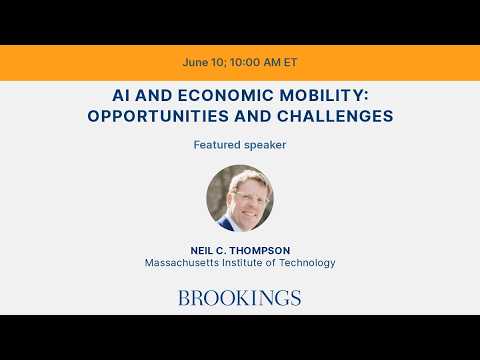
AI and economic mobility: Opportunities and challenges
The Signal
AI is currently trapped in a friction-filled adoption phase where initial productivity gains are often offset by significant oversight and process-redesign overhead. Neil Thompson, director of the MIT Future Tech Project, argues that while AI is not purely hype, the prevailing 'wave' narrative of sudden occupation-wide displacement is inaccurate; instead, the economic impact resembles a 'rising tide'—gradual, heterogeneous movement that allows for policy anticipation and planned institutional transition. The central dispute remains whether AI’s long-term trajectory inevitably concentrates power as capital-owned systems displace human labor, or if strategic policy can foster enough complementarity to keep the gains broad.
The Case
- AI progress is currently driven by compute-heavy scaling, but this trajectory is likely unsustainable as compute costs face severe limits within 3 to 7 years, potentially forcing a move toward more efficient, smaller models.
- Thompson’s research, based on an interdisciplinary group of 110 researchers, highlights a 'J-curve' adoption pattern where firms see initial efficiency declines from overhead and transition costs before achieving net productivity growth.
- Human-AI complementarity often beats full automation; in one insurance-industry case, using AI to pre-fill claims forms for human review improved efficiency by 8 to 10x, whereas full automation struggled with accuracy.
- The 'rising tide' framework suggests that automation acts on specific tasks rather than entire job categories, which explains why wage and employment impacts often diverge—as seen in the differing fates of taxi drivers and proofreaders.
- A survey of nearly 300 AI experts identified substantial short-term risks, including a non-zero probability of 1 million deaths and $100 billion in damages over the next five years, fueling the push for standardized risk taxonomies like those at risk.mit.edu.
- Institutional risks are forming around data-compute flywheels, such as in radiology, where model superiority attracts data that further cements a market leader’s monopoly position.
- Thompson advocates for trajectory-based regulation over reactive policy, noting that while the U.S. government should treat AI national security as a serious, Manhattan-Project-level concern, equity stakes in private AI companies remain an unsettled and risky policy recommendation.
The 1 Minute Signal Take
This is a rigorous, evidence-informed reality check that successfully deconstructs the extremes of AI doomerism and tech-bro utopianism. Skip the video if you only care about the high-level policy takeaways, but watch it if you want to see how Thompson’s team actually weighs technical performance against economic adoption—it adds a necessary layer of grounded skepticism that is difficult to convey in text.
Time saved:
Tags
Back to Feed