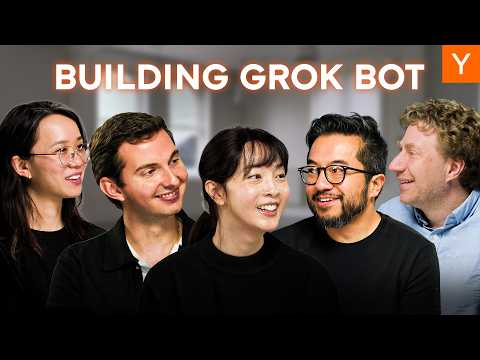
Grok Bot: What Changes When You Can Build AI Teammates

Video thumbnail: Grok Bot: What Changes When You Can Build AI Teammates
Nov 14, 20261h 6s video lengthY Combinator

The Signal

Grockbot — an AI-native platform where bots possess distinct identities, tool access, and operational autonomy — is transforming company workflows by moving execution from personal assistants into shared, multiplayer Slack threads. While the product is seeing rapid adoption for roles like marketing and procurement, the transition signals a shift where the primary bottleneck is no longer code execution, but intent specification and product vision. The team balances this velocity with a cautious, incremental approach to granting agent autonomy.

The Case

The Mechanism of Work

  • Work is shifting from private, single-player agent loops to public Slack threads where bots and humans collaborate; this visibility allows employees to learn and copy effective agent workflows across the company.30:52
  • Bots are designed to act as specialist teammates rather than generalist assistants, with the ability to own credentials, manage Google or Facebook ad budgets, and route customer support tickets from start to finish.4:04
  • The team uses a trust-based rollout model, starting bots in read-only mode before slowly granting them tool access, outcome ownership, and finally full job responsibility.21:30

Scaling Leverage

  • To reduce the high cost of exhaustive agent review, the team embeds product constraints, static analysis, and lint rules directly into the codebase, treating the code as a form of system memory.46:07
  • The team reports that Lauren Tan — a lead engineer on the project — is generating roughly 4,000 PRs per month by using these agentic workflows, though this figure is self-reported and reflects a high-volume, automated production style.22:50
  • A shared-bot model is replacing individual agent instances, allowing teams to encode best practices into a specialist bot that colleagues can reuse for tasks like data analysis or vendor procurement.13:04

Governance and Risks

  • The team maintains that human taste and internal dogfooding remain mandatory for major UX changes, even as minor bugs are automatically fixed and merged without human oversight.54:47
  • While the team envisions "AI-native" organizations with fewer layers of management, key governance challenges—specifically how to manage bot authentication, permissioning, and decision hierarchy—remain unresolved and unsettled industry-wide.16:07

The 1 Minute Signal Take

The move toward autonomous agents acting in shared spaces suggests that company infrastructure will increasingly be built around bots as first-class citizens. Success in this shift depends less on technical execution and more on an organization's ability to specify clear intent and encode rigorous product standards directly into their systems.

Pro Analysis

Why It Matters

This approach signals a transition from 'AI as a tool' (like a calculator) to 'AI as a teammate' (like a colleague). By giving bots identity and tool access, the development team is effectively re-architecting the modern organization, moving away from layers of middle management toward a model where ICs orchestrate autonomous agents.

Strategic Implications

Organizations that fail to adopt agentic workflows risk falling behind in execution velocity. The competitive advantage will no longer stem from the ability to code, but from the ability to manage intent, permissioning, and system-wide constraints effectively.

Evidence & Hype Audit

While the internal metrics (4,000 PRs/month) are impressive, they are self-reported and likely include automated maintenance tasks rather than high-level feature development. The '7-week launch' story highlights impressive agility, but the long-term robustness of these bots in high-stakes environments (like financial or legal) remains an open, untested question.

Counterarguments

Critics might argue that delegating too much agency to bots, even with 'trust ladders,' introduces a surface area for catastrophic failure that cannot be caught by static analysis. Furthermore, there is a risk that public agent threads in Slack will create overwhelming noise, drowning out human communication and damaging organizational culture.

Who Should Care

  • CTOs/Engineering Leads: Must decide how to integrate static analysis and codebase constraints to support agentic coding.
  • Product Managers: Need to shift from 'task-managing' to 'outcome-defining.'
  • Operations Managers: Should look for high-volume, repeatable tasks to delegate to domain-specific bots.

What to Do Next

  • Audit repetitive internal processes for potential automation.
  • Implement a 'read-only' AI agent to handle information retrieval tasks.
  • Establish clear guardrails before granting agents write or tool access.
  • Begin codifying team best practices into lint rules or static analysis.
  • Create a 'team-bot' pilot program for a non-critical business function.
Time saved:56m 34s

Share this

Tags

Written by: 1 Minute Signal Editorial Team