
Channel: Brookings Institution
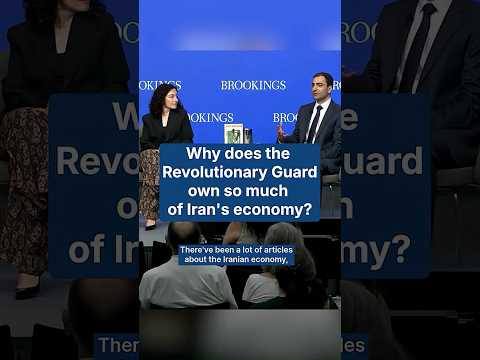
Why does the Revolutionary Guard own so much of Iran's economy?
The Signal
This briefing outlines the argument that the Iranian Revolutionary Guard Corps (IRGC) secured its massive economic position through a calculated, systematic takeover of private businesses. The speaker contends this reach, which they claim encompasses 80% of Iran’s economy, functions like an organized-crime operation using a coercive, multi-stage pressure cycle to force owners into submission.
The Case
- The book’s "startup section," authored by Said Rahmani, is cited as the primary case study detailing how the IRGC converts military, intelligence, and political leverage into absolute economic control.
- The IRGC’s takeover process is described as a mafia-style sequence: first exploiting existing power to exert pressure, then threatening families, feigning temporary friendship, and finally employing outright aggression to muscle competitors out of the market.
- The IRGC’s current regime influence is portrayed as a direct consequence of this economic empire, with the speaker asserting that state control is now largely concentrated among Revolutionary Guard figures.
- The speaker repeatedly cites an "80%" ownership figure for the Iranian economy, though they provide no evidence, sourcing, or audit data to substantiate this claim within the transcript.
The 1 Minute Signal Take
The explanation of coercive mechanisms offers a useful framework for understanding how non-state actors achieve market dominance, but the transcript itself functions only as an advertisement for the book's narrative. Skip this video, as the summary captures the entire evidentiary core, and the speaker’s broader claims remain entirely unsupported assertions.
Time saved:
Tags
Channel: Brookings Institution