I Tested the Viral Reverse Engineer Anything Skill. What You Need to Know.

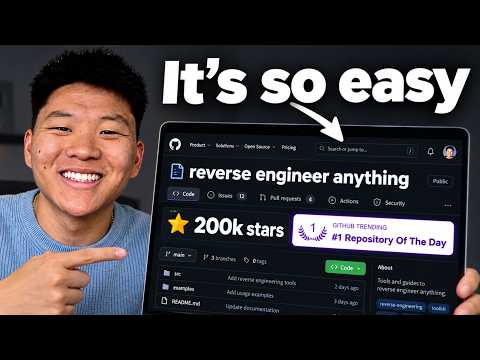
Video thumbnail: I Tested the Viral Reverse Engineer Anything Skill. What You Need to Know.
Oct 13, 202614m 59s video lengthNate Herk | AI Automation

The Signal

REA (Reverse Engineer Anything) is a trending GitHub framework that allows AI agents to study existing software and reconstruct its functionality. By treating an application as a de facto product requirements document (PRD), this workflow forces agents to decompose complex systems from observed evidence rather than relying on generic prompts, resulting in higher-quality, more faithful outputs at the cost of slower execution speeds.

The Case

The Workflow Mechanism

  • The REA process restricts agents to a structured sequence: selecting a specific feature, routing by tech stack, generating a summary of the target, and labeling every observation as "seen," "inferred," or "unknown."8:17
  • These epistemic labels are load-bearing; they prevent agents from treating speculative inferences as established facts, which the speaker—a developer showcasing the tool—argues is the primary cause of hallucinated build errors.9:36
  • The workflow is explicitly designed to handle large datasets, such as a Loom screen-recording analysis that initially spanned over a gigabyte of data, by forcing the AI to generate a summarized representation before attempting a reconstruction.8:59

Practical Outcomes and Tradeoffs

  • The speaker claims that while direct prompting of coding agents is faster, using the REA framework consistently yields superior results because the model is forced to work from a concrete role model rather than a vague goal.13:02
  • In a demonstration cloning Loom, the speaker built a local tool called Herk Recorder; it replicated functionality like the recording bubble and countdown, but the speaker emphasized that they cloned behavior, not UI or backend assets.3:51
  • To maintain legal and ethical boundaries, the speaker warns against hacking private systems or cloning protected source code, insisting the workflow should only inspect publicly accessible or local material.11:10

Generalizing the Concept

  • The broader thesis is that reverse engineering should move beyond software; by identifying successful processes or skills—like a high-performing editing style for Instagram reels—users can iterate their own workflows toward proven benchmarks.14:24
  • The speaker concedes that the core concept is not new but argues that the repo formalizes the practice into a repeatable, agentic process that makes sophisticated reverse engineering accessible to those without formal software backgrounds.13:54

The 1 Minute Signal Take

If you are struggling to align agents with a specific vision, stop writing long-form requirements and start providing high-quality, existing targets for the AI to deconstruct. The trade-off is higher latency, but the precision gained by forcing an agent to categorize its own evidence is currently one of the most reliable ways to reduce implementation drift.

Pro Analysis

Why It Matters

This workflow marks a transition from 'vibe-coding'—where results are unpredictable—to a more engineering-centric approach for AI agents. By utilizing an existing, high-performing artifact as the ground truth, users significantly reduce the search space for AI agents, which is essential for consistent, professional output.

Strategic Implications

Businesses can use this to quickly adapt successful competitor workflows. Rather than spending weeks writing specs, product teams can feed a competitor's feature into an REA-based agent to generate a baseline version. This effectively turns high-performing products into training data for one's own internal tools.

Evidence & Hype Audit

  • Hype Factor: High. The focus on GitHub star counts and the 'software is done' narrative is clearly sensational.
  • Evidence Quality: Moderate. The speaker provides multiple demos (Loom, Instagram reels), which is strong, but there is no formal benchmarking of the results. It is essentially a collection of successful anecdotes.

Counterarguments

Critics might argue that REA is merely a formalization of standard 'analysis-by-example' that skilled developers have practiced for decades. The 'novelty' may be overstated, as the primary value add is simply a user-friendly wrapper for existing prompt-engineering strategies.

Who Should Care

  • Product Managers: Use this to rapidly prototype features based on competitive benchmarks.
  • No-code Developers: Use this to bridge the gap between inspiration and complex functional implementation.
  • Engineers: Use this to automate the tedious documentation/spec-writing phase of development.

What to Do Next

  • Pick a single, small feature in an app you admire.
  • Define the stack you want to use for the reproduction.
  • Ask an AI agent to 'see, infer, and label' the behavior of that feature.
  • Run a 'rebuild and test' cycle to validate the model's assumptions.
  • Compare the agent-generated output against the target to identify where it missed nuance.
  • Refine your 'seen' versus 'inferred' lists to tighten the next iteration.
Time saved:11m 18s

Share this

Tags

Written by: 1 Minute Signal Editorial Team