
Channel: Council on Foreign Relations
Jamieson Greer on Whether Free Trade Brings Peace
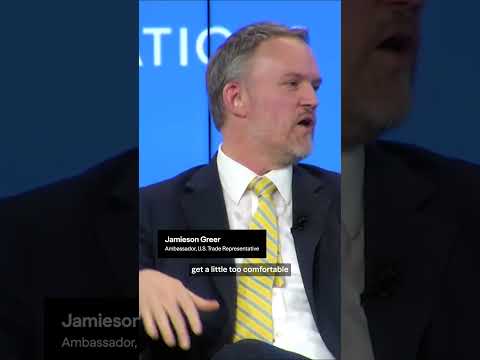
The Signal
The speaker challenges the prevailing economic theory that free trade inherently fosters global peace, arguing instead that prolonged peace breeds dangerous supply-chain complacency. He contends that security-critical industries must prioritize domestic resilience over unrestricted efficiency, specifically rejecting the idea that it is rational to source military components from potential adversaries. While he advocates for stronger domestic supply chains, he clarifies that he does not support full isolationism or autarky, instead calling for a more balanced trade approach.
The Case
- The speaker characterizes global logistics as a security liability, citing the potentially lethal absurdity of sourcing missile parts from countries most likely to engage in conflict with the importer.
- He explicitly dismisses the "free trade brings peace" thesis, identifying it as a flawed assumption that has caused nations to lower their guard regarding essential infrastructure.
- The speaker posits that extended periods of stability lead to a systemic drift where strategic rigor is sacrificed for short-term cost optimization.
- He describes the current shift toward reshoring and protectionism not as an anomaly, but as a "reversion to the mean," though he offers this analysis as an unsupported personal interpretation rather than an evidenced trend.
- He affirms that international commerce remains an structural certainty while arguing that "balanced" trade requires a deliberate reduction in reliance on foreign adversaries.
The 1 Minute Signal Take
The speaker’s argument essentially trades the efficiency of global markets for the perceived safety of domestic control, using a vivid but hypothetical example to anchor his security concerns. His framing of current events as a "reversion" is assertive but lacks empirical grounding. Skip this if you are already familiar with the strategic-resilience argument against liberalized trade, as the thirty-five-second duration offers no granular policy details or data beyond his broad conceptual pivot.
Tags
Channel: Council on Foreign Relations