
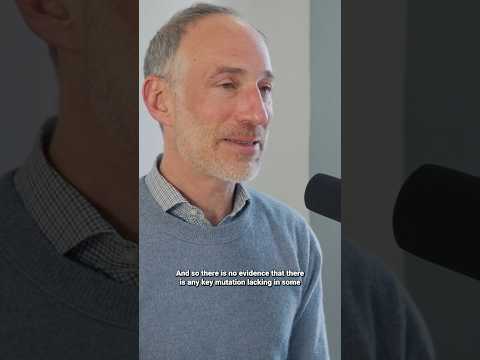
- Deep ancestral divergence does not correlate with an absence of key mutations needed for normal human functionality.
- Human populations function as fluid systems where trait averages adjust to external selection pressures rather than being fixed by ancient lineage.
- The pace of human trait evolution appears to have increased significantly over the most recent millennia compared to earlier epochs.
Channel: Dwarkesh Patel
Humans Share the Same Genetic Toolkit - David Reich
This discussion covers the intersection of deep ancestral divergence and recent trait evolution in humans, challenging assumptions about population-based functional differences.
Key Takeaways
- Populations with deep ancestral splits dating back 200,000 years show no evidence of lacking fundamental capabilities required for modern life.
- Genetic evidence suggests human populations hold sufficient latent variation to adapt and shift trait averages when faced with new environments.
- Recent research indicates significant movement in several important traits has occurred specifically within the last 18,000, 10,000, and 5,000 years.
Talking Points
Analysis
Strategic Significance
This perspective reframes 'biology' from a static destiny into a dynamic, responsive spectrum. By decoupling ancient lineage from current functional capacity, it simplifies the debate around human biological differences.
Who Should Care
Policymakers, sociologists, and geneticists should pay attention, as this narrative challenges the deterministic views often applied to population genetics in public discourse.
Contrarian Takeaway
Human evolution is currently moving faster than we assume; we are not merely the beneficiaries of ancient adaptations but are actively evolving at an accelerated pace due to recent shifts in our environment.
Channel: Dwarkesh Patel