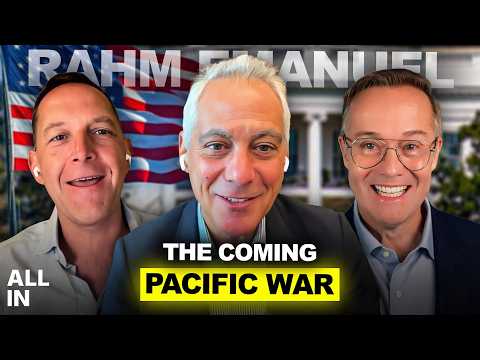
Rahm Emanuel: Trump's Foreign Policy, China, Europe's Decline, Immigration & DSA vs Democrats

Video thumbnail: Rahm Emanuel: Trump's Foreign Policy, China, Europe's Decline, Immigration & DSA vs Democrats
Aug 13, 20261h 11m 36s video lengthAll-In Podcast

The Signal

Rahm Emanuel, a seasoned Democratic operative and former ambassador to Japan, argues that America’s geopolitical standing rests on rebuilding domestic institutional capacity—education, immigration, and fiscal discipline—to anchor an allied economic bloc against China. He rejects the notion that the U.S. can rely on unilateral action, warning that China is already actively pressuring partners across the Indo-Pacific. The central tension lies between Emanuel’s call for targeted public investment and his hosts' insistence that government spending is the primary engine of cost inflation and fiscal instability.

The Case

Geopolitical Strategy

  • China is currently pressuring Japan, the Philippines, and other regional partners, creating a "happening now" security environment that requires planning for three contingencies: blockade, invasion, and incremental island seizure.22:10
  • Emanuel proposes isolating China by aggregating an economic bloc comprising Japan, South Korea, Taiwan, Australia, the EU, and Latin American partners rather than relying on unilateral tariffs.16:26
  • He frames the U.S. research apparatus—NIH, NSF, DARPA, and national labs—as a "crown jewel" essential for national security, arguing that attempts to slash their budgets constitute strategic self-sabotage.15:28

Domestic Policy

  • Emanuel advocates for an education-to-workforce pipeline that includes universal pre-K, high-school redesign, and modern community colleges tied directly to regional labor demands like broadband and submarine manufacturing.55:17
  • He supports a compromise approach to immigration—specifically the bipartisan Dignity Act—that pairs strict border enforcement with an expansion of legal, skills-based entry for the "best and brightest" global talent.40:26
  • Regarding fiscal policy, he argues that spending cuts alone cannot stabilize the debt, proposing a five-year spending cap paired with tax reforms that discourage wealth preservation in favor of productive investment.67:19

Areas of Contention

  • Emanuel disputes the hosts' claim that Europe’s current instability is primarily a product of "leftist policy," pointing instead to specific cross-party decisions like Germany’s nuclear shutdown and Merkel-era refugee policies.34:00
  • He rejects the idea that public spending is the singular driver of rising costs in housing, education, and healthcare, noting that regulatory bottlenecks and zoning constraints are often the primary barriers to affordability.51:02

Political Alignment

  • Emanuel defines his electoral strategy as coalition-building for general-election wins, explicitly dismissing the DSA as a separate-party movement that distracts from defeating Republicans.69:25

The 1 Minute Signal Take

Emanuel presents a technocratic vision where U.S. power is reclaimed through the steady alignment of allied markets and internal institutional reform. His argument hinges on the premise that America’s global influence is fundamentally a mirror of its domestic competence, placing the burden of future stability on the ability to execute long-term administrative priorities rather than short-term ideological posturing.

Pro Analysis

Why It Matters

Rahm Emanuel represents the 'muscular centrist' school of American policymaking. His arguments suggest that the current p...
Full analysis always available on Pro.

Time saved:1h 9m 19s

Share this

Tags

Written by: 1 Minute Signal Editorial Team