The Key to Quantum Computing

Video thumbnail: The Key to Quantum Computing
Jul 10, 20262m 1s video lengthQuanta Magazine

The Signal

Quantum computing is defined by a two-decade-long race to build a machine capable of solving classically intractable problems. The primary challenge is not engineering better qubits, but overcoming their inherent fragility: since qubits exist in continuous states, they are prone to errors that can collapse an entire calculation. The field's current focus is on a technique called error correction to turn many unreliable physical qubits into one stable logical qubit.

The Case

  • Quantum computers are designed to solve problems beyond classical machine capability by utilizing unique properties like superposition, where qubits exist between 0 and 1, rather than the binary 0 or 1 of classical bits.0:29
  • The fundamental barrier to progress is that qubits are extremely volatile, and because state errors occur on a continuum, any single error can cascade to invalidate the entire computation.0:47

The Error Correction Approach

  • Peter Shor, a mathematician who provided a critical theoretical foundation in the 1990s, realized that adding extra qubits could allow for error correction in principle.
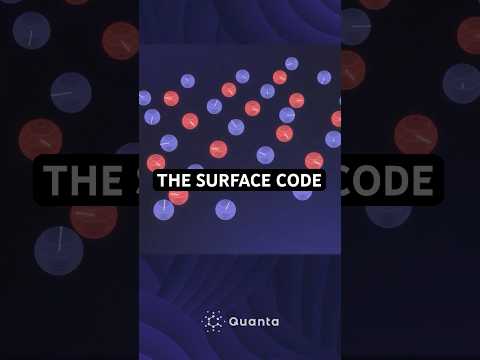
  • In 1998, Russian physicist Alexei Kitaev proposed the "surface code" to operationalize this, suggesting that qubits be arranged on a square lattice using local measurements to identify and suppress errors.1:11
  • The resulting architecture organizes physical qubits into overlapping grids of data and measurement qubits, allowing the system to combine many individual, unreliable parts to express one higher-quality logical qubit.1:28
  • While the surface code is characterized as a surprisingly simple scheme, the practical realization of a scalable, fault-tolerant computer remains an ongoing, unresolved engineering challenge rather than a finished breakthrough.

The 1 Minute Signal Take

The central trade-off in quantum development is the sacrifice of scale for stability: by requiring many physical qubits to create a single usable logical one, the engineering burden grows geometrically. Success depends entirely on whether this surface code or similar methods can suppress error rates beyond a specific threshold to maintain coherence at scale.

Pro Analysis

Why It Matters

Quantum computing is often framed as a hardware problem, but this content correctly identifies it as a control and archit...

Full analysis always available on Pro.

Time saved:16s

Share this

Tags