can you quantify slop?

Video thumbnail: can you quantify slop?
Sep 17, 20266m 16s video lengthJaymin West

The Signal

As LLMs prove highly capable at generating individual snippets of code, a critical tension emerges: the difference between generating code and executing software engineering. The speaker argues that agent-driven systems risk accumulating "slop"—a structural decay that creates unmaintainable codebases—and proposes quantifying this via specific metrics to enforce quality during development.

The Case

Metrics and Strategy

  • The speaker defines code "slop" through two structural measures: verbosity, which tracks unnecessary code duplication, and erosion, which identifies functionality trapped in overly large, concentrated functions.1:02
  • Drawing inspiration from a recent blog post by Sebastian at Iendale, the speaker argues that while agents excel at syntax, they require guardrails to maintain system-level cleanliness.0:20
  • The proposed workflow treats the audit as a gate, running inside CI or commit hooks to block agents from introducing additional slop before code is merged.4:38

Project Demo and Future

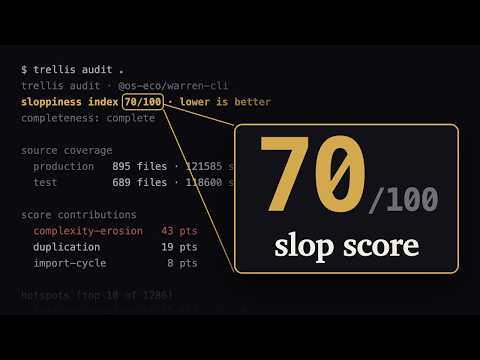
  • The speaker audited his own project, Warren—a 250,000-line codebase he claims is entirely agent-written—and received a score of 70/100, where lower indicates better structural health.2:19
  • Trellis, the open-source tool used for this audit, is currently in early development and supports only TypeScript, though the speaker intends to expand it based on community interest.
  • The intended agentic loop involves feeding audit results into a model's context window, tasking it to refactor the codebase to reduce slop while strictly preserving existing behavior and repository boundaries.3:36

The Open Question

  • The speaker explicitly presents it as an open question whether sloppiness can be reliably reduced to a quantitative metric or if it will remain a largely qualitative, "know it when you see it" judgment.6:05

The 1 Minute Signal Take

The speaker’s proposal shifts the human role from writing code to defining system-level architectural constraints and reviewing machine-readable health metrics. Whether this tool can effectively scale beyond his specific prototype remains unproven, as the efficacy of these metrics in capturing true maintainability is still contested.

Pro Analysis

Why It Matters

As autonomous agents move from generating simple snippets to building entire systems, the traditional human-centered code review process is collapsing. We are facing a future where codebases could become fundamentally unmaintainable at a speed far faster than human engineers can audit. Quantifying 'slop' is the first step toward reclaiming agency over these automated systems.

Strategic Implications

This approach signals a move toward 'defensive engineering' in an AI-native world. Rather than trusting LLMs to produce clean code, organizations must treat codebases as dynamic environments requiring constant automated pruning. It shifts the burden of engineering from writing code to defining the constraints and metrics that govern that code.

Evidence & Hype Audit

This is a highly experimental, early-stage project. The 'evidence' provided is a single data point (a 70/100 score on the author's own project). The content is less of a proven methodology and more of an 'invitation to experiment.' It avoids over-promising but acknowledges the difficulty of defining 'slop' mathematically.

Counterarguments

Critics might argue that code metrics are inherently brittle and easily gamed. If agents are optimized to hit a specific 'slop score,' they might find ways to reduce verbosity while obfuscating logic in ways that are even harder to debug. Furthermore, some argue that 'slop' is an aesthetic preference that defies quantification.

Who Should Care

  • Engineering Leads: Responsible for long-term codebase health in agent-heavy teams.
  • AI Tool Builders: Focused on agent autonomy and pipeline integration.
  • Individual Contributors: Managing high-velocity agentic workflows.

What to Do Next

  • Audit your own codebase to establish a baseline 'slop' score.
  • Analyze the 'erosion' metrics to see if your code is consolidating into problematic bottlenecks.
  • Implement a 'clean-up' loop where an agent addresses high-verbosity sections.
  • Evaluate the feasibility of adding an automated quality gate in your local commit hooks.
Time saved:3m 6s

Share this

Tags

Written by: 1 Minute Signal Editorial Team