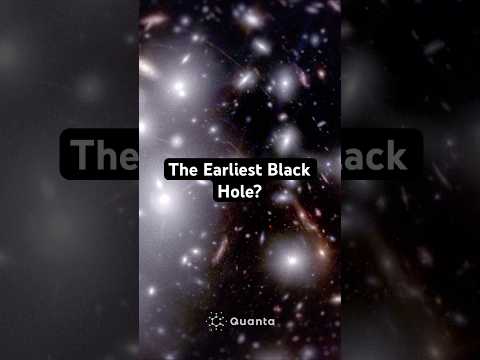
Little Red Dots #physics

Video thumbnail: Little Red Dots #physics
Jun 22, 20262m 20s video lengthQuanta Magazine

The Signal

QSO1, a supermassive black hole discovered by the James Webb Space Telescope, is challenging standard cosmic formation theories. Its existence appears to precede nearby stars, a scenario that contradicts typical galaxy-first models. The central tension lies in whether these 'little red dots' are true anomalies or simply misunderstood phenomena as scientists work to reconcile observed data with existing physics.

The Case

  • QSO1 is a confirmed supermassive black hole in the early universe, weighing approximately 50 million suns and displaying extreme dominance over its immediate surroundings.0:17
  • Researchers observed virtually no trace of a host galaxy around the black hole, a finding that stands as the most puzzling aspect of the discovery.
  • Gas orbiting the object contains only hydrogen and helium, which scientists interpret as primordial material that has not been enriched by previous star cycles.0:53
  • The claim that this black hole formed before local stars is an inference drawn from the lack of galactic light and the chemical profile, rather than a proven chronological sequence.
  • Current explanations for how this object formed are incomplete; astronomers are overconfident in calling this a definitive 'paradigm shift' until predictive theories are tested against new data.1:31
  • Future validation depends on continued Webb observations and data from the forthcoming LISA space mission, which will use lasers to detect gravitational waves from massive, distant events.

The 1 Minute Signal Take

This video succeeds as a high-level briefing on a genuine scientific anomaly but suffers from the narrator’s reflexive, over-the-top framing of the discovery as a paradigm shift. The observational evidence is compelling, but the theoretical conclusions are currently speculative. Skip the video if you only need the technical status; watch it if you want an accessible breakdown of why the 'galaxy-first' formation narrative is currently under pressure.

Pro Analysis

Strategic Significance

  • This discovery represents a potential "anomaly-driven" shift in astrophysics. By questioning the chronological order of black hole and galaxy formation, it challenges the hierarchical assembly model that has dominated cosmology for decades. It forces a refinement of how we model the early universe's mass distribution.

Who Should Care

  • Astrophysicists and cosmologists, specifically those working on galaxy evolution and supermassive black hole formation models, stand to gain the most from this. It also matters to those invested in the next generation of space observatories, as it justifies the resource allocation for JWST follow-ups and the LISA mission.

Contrarian Takeaway

  • The absence of evidence is not the evidence of absence: the "missing galaxy" may not be a true structural anomaly, but rather a limitation of currently available telescopic sensitivity. The most "revolutionary" claims in the transcript may simply vanish once deeper exposure data corrects the observational bias.
Time saved:2s

Share this