How Pendo used LangSmith to trace Novus from user behavior to code fixes

Video thumbnail: How Pendo used LangSmith to trace Novus from user behavior to code fixes
Jul 1, 20262m 55s video lengthLangChain

The Signal

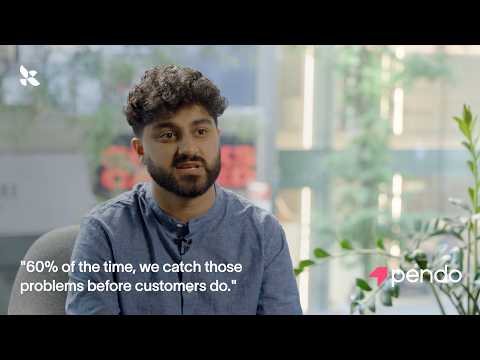
Zain Lakhani, the Chief AI Officer at Pendo, describes using automated observability to build and maintain 'Novus,' a product agent designed to convert user interactions into improvement insights. The challenge lies in moving beyond surface-level aesthetics to ensure the agent actually provides the correct signals and fixes for real user needs.

The Case

Evaluation and Process

  • Novus measures success against two specific criteria: surfacing the correct insight and suggesting the correct fix, rather than relying on qualitative 'looks good' feedback.0:48
  • The team maintains a daily operational cadence where they review trace dashboards—data logs generated by LangSmith—to compare what customers are actually asking against what the agent is configured to support.1:37
  • To expand capabilities, the team identifies the top seven use cases from real traces, adding these to automated evaluation sets while running regression checks to ensure original use cases do not degrade.1:18

Performance and Reliability

  • Lakhani reports that approximately half of incoming user requests are currently unsupported by the agent, a bottleneck that manifests as errors or unexpected responses.
  • To manage this mismatch, the team uses their trace-based observability to identify these failed requests, claiming they catch and resolve these issues before customers encounter them 60% of the time.1:59
  • While Lakhani asserts that having this observability directly scaled their design partner base, this remains a self-reported claim without independent verification offered in the video.

Stack Architecture

  • The internal stack separates instrumentation by layer: Novus instruments product usage, while LangSmith instruments the agent's behavior.2:44
  • LangChain is utilized as the primary build framework to accelerate the path from a proof-of-concept to a production-ready agent.

The 1 Minute Signal Take

The core takeaway is that production-ready AI agents require proactive observability to bridge the gap between development assumptions and actual usage. By treating trace data as the primary source of truth for evaluation sets, teams can move from anecdotal testing to a systematic, high-coverage feedback loop.

Pro Analysis

Why It Matters

This case study highlights the shift from experimental 'chatbots' to 'AI product agents' that must reliably impact business outcomes. It demonstrates that the path to production-grade AI is less about model architecture and more about the maturity of the instrumentation and evaluation pipeline.

Strategic Implications

For enterprises, this signals that the 'build' phase is only the beginning. The competitive advantage lies in the 'operate' phase, where teams that can systematically turn real-world failure modes back into automated test cases (eval sets) will outpace those relying on manual debugging.

Evidence & Hype Audit

  • Trustworthiness: Moderate. The speaker provides specific operational cadences and clear definitions of success.
  • Risk: Much of the reported impact—such as the '60% of the time' success rate and the scaling of design partners—is self-reported and lacks third-party verification. It should be treated as an organizational success story rather than a benchmarked statistic.

Counterarguments

Critics might argue that such heavy instrumentation and daily manual review represent an unsustainable 'human-in-the-loop' burden, which may be difficult to maintain as a product hits full-scale adoption. There is also the potential for 'over-tuning' to the specific traces of early partners, leading to brittle agents.

Role-Specific Takeaways

  • Product Managers: Focus on defining successful outcomes (surface signal vs. suggest fix) rather than just interface features.
  • Engineers: Prioritize building for observability at the agent level simultaneously with the initial product build.

What To Do Next

  • Conduct an audit of your current agent's 'failure modes' to see if they are categorized clearly.
  • Integrate trace-capture tools into your early POC environments.
  • Establish a 'morning review' cadence for your most active production flows.
  • Build a process to automatically convert new user queries into regression test cases.

Share this

Tags