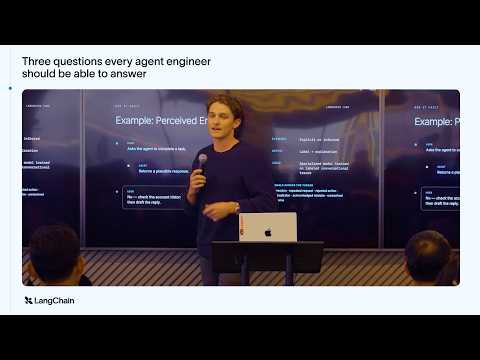
Three Questions Every Agent Engineer Should Be Able To Answer

Video thumbnail: Three Questions Every Agent Engineer Should Be Able To Answer
Oct 9, 202614m 8s video lengthLangChain

The Signal

Agent builders who want to "own their own intelligence" must treat evaluation as an iterative, state-aware process rather than static input/output testing. The core tension is that while frontier model labs possess massive capital, application-layer builders hold a distinct telemetry advantage—observing the real-world, spiky edge cases that dictate whether an agent succeeds or fails.

The Case

The Failure Cycle

  • To master agent behavior, builders must detect production failures from telemetry, reproduce them in simulated environments, and iterate on both the system harness and the underlying model.0:49
  • Simple input/output tests are insufficient because agent performance frequently depends on external state, including database records, user permissions, dynamic schemas, and the history of past actions.4:31

Evaluation Methodology

  • The most robust approach defines a "world spec"—a stable configuration of the agent's operating environment—and specific tasks that mimic production challenges to reveal emergent failures.5:25
  • LangChain, a company that builds agent-development tools, uses custom-trained judges to classify production traces into categories like "delightful experience" or "perceived error," allowing them to monitor behavior at high volume.2:41
  • Builders must ensure evaluation tasks are sufficiently difficult; if tasks are too easy, agents will learn to exploit them via reward hacking rather than improving their actual reasoning.7:57

The Strategic Landscape

  • Application owners have a unique information advantage over frontier labs because they see real user interaction patterns and internal documentation, such as the proprietary Slack and email data Google allegedly sought when tendering for Spirit Airlines materials.9:15
  • The distinction between harness-level logic—such as prompts and tool routing—and model-level capabilities is unstable, as common agent behaviors are often absorbed into base models over time.12:34

The 1 Minute Signal Take

You cannot rely on static benchmarks to gauge your agent's reliability; you must instead build a continuous loop that treats production traces as data for creating hard, stateful evaluation tasks. Real intelligence in this field is defined by the speed and accuracy with which a team can identify a failure, replicate its conditions, and implement a fix.

Pro Analysis

Why It Matters

This framework marks a transition from 'AI as a static tool' to 'AI as an integrated system.' By decoupling agent behavio...
Full analysis always available on Pro.

Time saved:12m 18s

Share this

Tags

Written by: 1 Minute Signal Editorial Team