
Channel: Greg Isenberg
Claude Fable 5 is BANNED. What to do?
The Signal
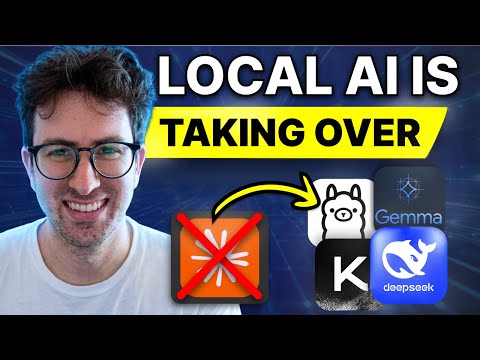
Local AI models have reached a threshold where they can handle most routine digital tasks, effectively serving as an 'owned' insurance policy against the fragility of frontier cloud services. The central tension lies in the strategic risk of relying on rented intelligence; the speaker argues that Friday-evening shutdowns of high-end models by government request prove that cloud dependency is a liability which businesses and individuals must hedge by keeping part of their AI stack on local hardware.
The Case
- Frontier model access is described as a fragile dependency, exemplified by the sudden disabling of a model—referenced as 'Fable 5'—following a Friday afternoon letter from the US government to Anthropic, the AI company behind the model.
- The speaker claims that a practical shift occurred roughly six months ago, after which well-equipped laptops or gaming GPUs became capable of handling approximately '80%' of common cloud-based AI tasks.
- To implement this, the speaker argues users must reverse common behavior by first installing an inference runtime like Ollama, a command-line tool for local execution, or LM Studio, a graphical interface suitable for non-technical users.
- Quantization, specifically using 'Q4' or 'Q5' variants, is presented as the essential technical enabler; it compresses these models to fit onto personal hardware with minimal loss in functional quality.
- The speaker proposes high-value commercial openings in sectors where data cannot legally or physically leave the premises, such as healthcare, defense, and remote operations in places like ships or rural field sites.
- While the speaker asserts that 'Hermes'—a local-running agent architecture—is currently the most used in the world, this specific claim is unsupported by any provided data or reference point.
The 1 Minute Signal Take
The speaker’s argument succeeds as a strategic hedge: it draws a clear line between the peak capability of specialized cloud models and the sovereign resilience of local ones. While the claim regarding '80%' adequacy is a subjective estimate rather than a hard benchmark, the technical guidance is rigorous and actionable for anyone concerned about uptime or data privacy. Watch it if you want the concrete setup walk-through, but skip it if you are already familiar with the Ollama-to-local-LLM workflow.
Time saved:
Tags
Channel: Greg Isenberg