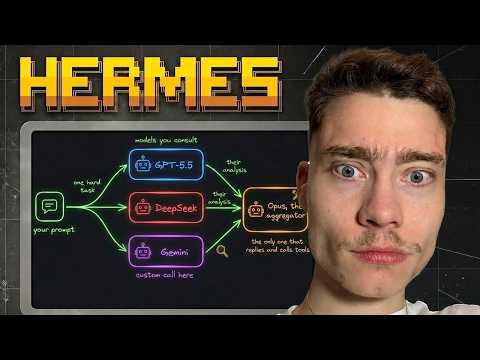
Hermes Agent just reached Fable level… Mixture Of Agents

Video thumbnail: Hermes Agent just reached Fable level… Mixture Of Agents
Jun 29, 202636m 1s video lengthDavid Ondrej

The Signal

The "Mixture of Agents" (MOA) workflow, as demonstrated via the Hermes Agent, orchestrates multiple AI models in parallel to produce a single, aggregated output. While the speaker asserts this approach outperforms the best publicly available models, the core trade-off remains higher latency and costs compared to single-model execution for high-value tasks.

The Case

The Workflow

  • Hermes Agent integrates a Mixture of Agents preset, allowing users to define a set of reference models—such as GPT 5.5, DeepSeek, or GLM 5.2—that process inputs simultaneously before an aggregator model, like Opus 4.8, synthesizes the final response.0:00
  • The demonstrated setup runs on a Hostinger VPS managed via CMAX—a terminal multiplexer—allowing an autonomous PI agent to monitor progress, detect stalls, and provide steering prompts when the primary model freezes.4:25
  • The process end-to-end built and deployed a functional 3D game to a public URL with minimal human intervention, though the speaker notes the setup cost reached approximately $20 due to the high volume of parallel tokens.21:36

Strategic and Practical Claims

  • The speaker frames MOA as a strategic necessity for users wary of closed-model companies like OpenAI and Anthropic, which are accused of withholding their most capable systems from public API access.0:58
  • Performance claims—such as MOA surpassing frontier models like GPT 5.5—are asserted by the speaker rather than verified by external benchmarks; the workflow relies on the aggregator's ability to orchestrate diverse model strengths rather than raw parameter size.0:33
  • The speaker explicitly differentiates MOA, which uses multiple complete AI models, from Mixture of Experts architectures, which utilize a single sparse model architecture to optimize local compute resources.3:05

The 1 Minute Signal Take

This workflow offers a high-leverage method for tackling complex tasks like code architecture and debugging by orchestrating existing model subscriptions, provided you are willing to manage higher operational costs and VPS configurations. While the superiority of this approach over single frontier models remains anecdotal, the demonstrated utility of multi-agent supervisor loops for autonomous deployment is a clear tactical advancement.

Pro Analysis

Why It Matters

This workflow represents a shift from 'using AI' to 'managing AI infrastructure.' By treating LLMs as modular components ...

Full analysis always available on Pro.

Time saved:34m 13s

Share this

Tags