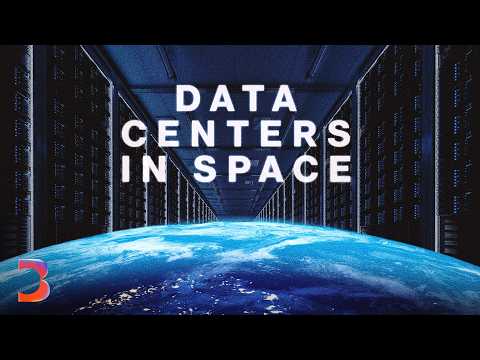
Jun 16, 202613m 24s video lengthBloomberg Originals
The Signal
Orbital compute describes an emerging, highly theoretical effort to relocate energy-intensive AI data centers from Earth into space. Proponents argue this would bypass terrestrial bottlenecks like land scarcity, local permitting, and mounting power demands. The core contention is whether large-scale deployment can overcome severe technical constraints—thermal rejection, orbital congestion, and launch economics—to turn these early prototypes into a reliable internet backbone.
The Case
AI-driven power demand is hitting an 'energy wall' on Earth, with data center electricity use expected to double by 2030 and reach one-tenth of global supply by 2050.0:36
Starcloud — a startup that launched the Starcloud 1 prototype in late 2025 carrying an Nvidia H100 chip — admits its hardware is not yet a functional data center, serving only as a developmental test bed.2:50
The engineering hurdles for orbital compute are complex and interdependent; developers are testing perovskite solar cells, specialized radiators to shed heat in a vacuum, and low-power propulsion for collision avoidance.4:22
Both Starcloud and the Singaporean company Transcelestial argue that laser communications, which they claim offer over 1,000 times the bandwidth of traditional radio frequency systems, are essential to making orbital processing viable.6:45
China is currently leading in deployment volume, having launched 12 of a planned 2,800 satellites for its state-funded Three-Body Computing Constellation; the project is explicitly framed as a competitive precursor to future internet infrastructure.10:25
Launch economics remain prospective; while SpaceX asserts that full reusability of its Starship vehicle could cut costs by 50 to 100 times, these are current internal targets rather than demonstrated financial facts.8:28
The 1 Minute Signal Take
This premise is speculative, technically nascent, and currently relies on a collection of optimistic projections regarding launch costs and orbital engineering. While the terrestrial constraints on AI infrastructure are genuine and well-documented, the leap to an orbiting data-center architecture is currently more of a strategic vision than a proven industrial model. Skip this video unless you specifically need the visual breakdown of the planned solar array and orbital networking designs.
Pro Analysis
Strategic Significance
The shift to orbital compute marks the transition of space from a research environment to a critical industrial...