Fable 5.2 Prompting: I REALLY Tested Anthropic's Advice

Video thumbnail: Fable 5.2 Prompting: I REALLY Tested Anthropic's Advice
Nov 12, 20266m 15s video lengthMervin Praison

The Signal

Anthropic recently overhauled its Fable 5.2 prompting guide, shifting the recommended approach for steering code generation and behavior. This update challenges the utility of legacy prompt boilerplate, suggesting that old 'never' rules and hard constraints may be actively counterproductive. The core trade-off centers on whether to adopt new, maintenance-focused instructions or retain established custom directives for reliability.

The Case

The Ownership Line

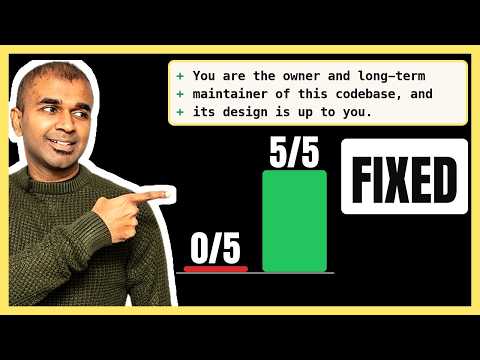
  • Adding the instruction, "You are the owner and long-term maintainer of this codebase, and its design is up to you," dramatically improved code deduplication in the speaker’s tests, moving from zero tidy runs to five out of five.2:01
  • This ownership line also fixed a hidden bug in every run without being explicitly requested, though it occasionally altered unintended sections of old code and inconsistently summarized modified files.

Prompt Cleanup

  • Retaining legacy 'never' rules can suppress useful actions, specifically retries; deleting the instruction "never retry a failed command" increased successful completion rates from 2/6 to 6/6.3:08
  • Rewriting such prohibitions into conditional instructions, like specifying when retries are permitted, achieved consistent success (4/4) without the risks associated with total deletion.
  • Hard word-count limits previously thought to make output choppy had negligible impact, shortening sentences by only two words, while explicit audience framing proved more effective for improving report style.3:45

Thinking and Costs

  • The directive to "answer directly without deliberating" did not suppress model thinking on trivial questions, as no thinking occurred regardless; the command served only to reduce word counts from 16 to 10.4:18
  • Token costs across these tests were generally lower than expected, with the ownership line using about 8% fewer tokens, suggesting that prompt selection should be driven by desired behavioral outcomes rather than anticipated token usage.4:48

The 1 Minute Signal Take

Prompt engineering is moving away from rigid, absolute prohibitions toward outcome-oriented framing. You should audit your existing prompt libraries to remove unconditional 'never' rules and manually verify diffs when using new maintenance-style instructions, as they may prioritize tidiness over strict adherence to minimal-change requests.

Pro Analysis

Why It Matters

This analysis highlights a fundamental shift in AI interaction: moving away from 'magic incantations' toward intentional role-based and condition-based prompting. It signals that models have become sophisticated enough to interpret intent rather than just blindly following rigid syntax.

Strategic Implications

Prompt engineering is shifting from a search for universal 'hacks' to a task-specific configuration. Companies relying on stale prompt libraries are likely experiencing degraded performance. Strategy should pivot toward modular prompt components tailored to specific outcomes (e.g., cleanup vs. surgical editing).

Evidence & Hype Audit

The content is highly trustworthy because it relies on repeated, on-camera experimental runs rather than theoretical claims. It acknowledges the limitations of the findings—explicitly noting that these are task-specific observations—which provides a welcome, grounded perspective compared to the usual 'AI hack' content.

Counterarguments

The primary counterpoint is that prompt behavior is inherently brittle. What works for a toy shop project may fail in a massive, complex enterprise codebase. Additionally, the 'hidden bug' fixing described might be seen as an unwanted side effect in production environments where strict adherence to requested changes is mandatory.

Who Should Care

  • Software Engineers: Transitioning to AI-assisted coding need to manage the model's agency.
  • AI Product Managers: Should re-evaluate platform-specific default prompts.
  • Power Users: Who maintain large "CLAUDE.md" or similar system instruction files.

What To Do Next

  • Conduct a "prompt audit" by removing all unconditional "never" rules.
  • Implement a modular system prompt strategy where specific lines are toggled based on task type.
  • Use the ownership line exclusively for refactoring tasks, not for small, isolated bug fixes.
  • Explicitly define the target audience in report-generation prompts rather than using word-count limits.
  • Establish a manual review process for any task where the model is given architectural ownership.
Time saved:3m 2s

Share this

Tags

Written by: 1 Minute Signal Editorial Team