Using Jev In Your Agent Harness

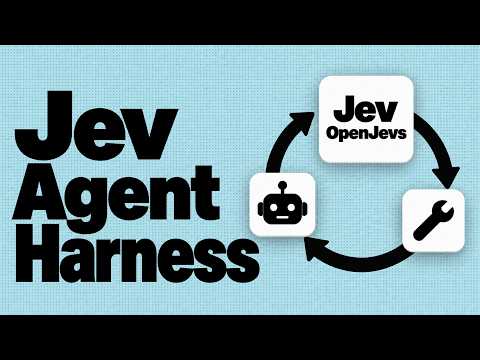
Video thumbnail: Using Jev In Your Agent Harness
Sep 29, 202620m 25s video lengthSam Witteveen

The Signal

Agent harnesses often default to full LLM calls for every step, causing unnecessary token waste and latency. The core proposal is to delegate discrete, bounded decisions—such as tool selection, safety gating, and result reranking—to specialized decision models like Jev. This approach replaces generative reasoning with fast, typed logic where appropriate, reserving LLMs for text synthesis and multi-step reasoning.

The Case

Harness Integration

  • Many agent operations are actually discrete decision points rather than open-ended prose generation; these include loading specific tools, checking safety before tool execution, and determining whether an agent result is 'good enough' to return to the user.0:00
  • Developers can hook these decision models into four specific points in an agent loop: before the prompt is built, before the model call, before a tool executes, and after a result returns.7:44
  • Progressive disclosure is a proven pattern for reducing prompt bloat: instead of injecting 50 skills into the context, an agent first selects a skill category from a list and then chooses the relevant specific skill, drastically lowering token overhead.5:57

Limitations and Tradeoffs

  • Decision models are strictly inferior for tasks requiring generative text, multi-step reasoning, or combining multiple disparate pieces of information into a single coherent answer.9:17
  • Long-context state—such as 100,000 tokens—significantly degrades the accuracy of decision models, according to documentation from Typesafe, the organization behind Jev.9:45
  • Prompt injection remains a genuine vulnerability, as decision models can be steered by malicious content they are assigned to inspect; implementers should use a pre-check to scan for injection before trusting the model's output.10:45
  • While open-source decision models offer better privacy by running locally, avoiding the cloud-trust concerns associated with sending state to hosted APIs, they are not universally validated; effectiveness varies by task, input size, and model choice.

RAG Optimization

  • Decision models can transform RAG pipelines by scoring or ranking retrieved passages at the decision layer, allowing the system to pass only the top five most relevant chunks to the final LLM call.16:28
  • This reranking approach often removes the need for separate, heavy-duty reranker models, provided the criteria for ranking are defined explicitly by the developer rather than left to the model to invent.18:05

The 1 Minute Signal Take

Decision models are a practical optimization for agent harnesses, provided you treat them as 'smart if statements' for bounded tasks rather than general-purpose reasoning engines. If your agent is spending its budget on logic, routing, or filtering, moving these to typed decision models is a high-leverage move; if the task requires synthesis, keep the full LLM in the loop.

Pro Analysis

Why It Matters

Agent development is currently stuck in a 'prose-everything' trap. By framing harness steps—such as reranking or safety c...
Full analysis always available on Pro.

Time saved:18m 8s

Share this

Tags

Written by: 1 Minute Signal Editorial Team