
Why It Matters
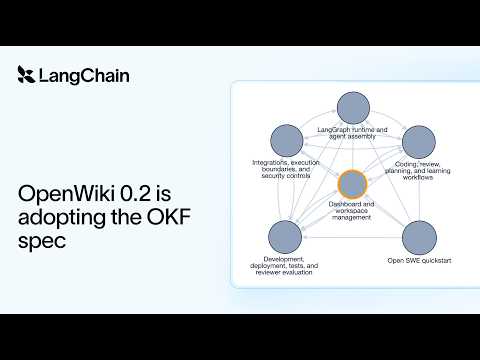
This is a classic transition from a prototype-grade architecture to a production-grade schema. By adopting a standard like OKF, OpenWiki is trading document autonomy for system consistency. This reduces the friction for autonomous agents interacting with the wiki, effectively 'indexing' the wiki for machines rather than just for human readers.
Strategic Implications
Adopting an external spec like OKF creates a dependency on an external ecosystem. While this yields immediate benefits—such as the cited Google visualizer—it ties the trajectory of OpenWiki's internal navigation to the evolution of the OKF spec itself. If the spec changes, OpenWiki must adapt.
Evidence & Hype Audit
This content leans toward 'product announcement'—it is optimistic and assertive. The speaker avoids providing benchmarks (e.g., 'X% increase in retrieval speed'), relying instead on the inherent logic that metadata filtering is superior to agentic scanning. The 'robustness' of the ecosystem remains the most unproven claim; one reference to a single Google tool does not guaranteed a thriving ecosystem.
Counterarguments
The primary risk is the overhead of maintenance. Requiring consistent YAML front matter in every single document imposes a 'data entry tax' on contributors. If users neglect the metadata or populate it inconsistently, the deterministic search filters will break, potentially leading to worse outcomes than the previous fuzzy, agentic approach.
Who Should Care
- Platform Architects: To evaluate the benefits of enforcing metadata standards on unstructured file stores.
- Open Source Maintainers: To judge whether adopting industry-standard specs like OKF is worth the loss of implementation flexibility.
- Agent Developers: To see how deterministic metadata can be used to optimize RAG (Retrieval-Augmented Generation) pipelines.
What To Do Next
- Conduct a gap analysis of your current documentation to see how much metadata will be required to reach OKF compliance.
- Define a schema within your team to ensure consistency in 'Tags' and 'Types' to avoid query fragmentation.
- Test the Google OKF visualizer with a subset of your data to verify if it provides sufficient value for your specific use case.
- Monitor the OKF specification for updates that might force future refactors of your documentation pipeline.