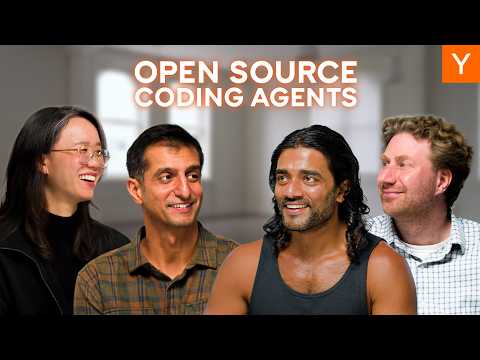
Opencode CEO: Blocked, 20X Growth in 6 Months, Building the Coding Agent for the World

Video thumbnail: Opencode CEO: Blocked, 20X Growth in 6 Months, Building the Coding Agent for the World
Jul 24, 202644m 27s video lengthY Combinator

The Signal

Open Code has emerged as a major player in coding agents, claiming ~13M monthly actives and 7T tokens processed daily. The company's growth is driven by its model-agnostic architecture, which allows users to swap between cheaper open-source models and frontier alternatives, creating a durable demand engine that benefits from competition rather than picking model winners.

The Case

Scaling and Growth

  • Open Code reports roughly 13 million monthly active users as of late June 2026, marking a 20x increase since the start of the year.1:37
  • The business now handles approximately 7 trillion tokens daily, positioning it as a significant customer for model labs, including being the largest token consumer for most open-source models.
  • Revenue has followed this scale, with recent data extrapolating to an annualized run-rate of approximately $38–40 million from subscriptions and inference.2:02

Market Inflection and Adoption

  • Anthropic’s January 2026 attempt to block Open Code users from routing Claude-branded subscriptions through the platform unintentionally accelerated Open Code's growth by publicizing the startup as a viable, neutral harness.3:53
  • Adoption is globally distributed, with China accounting for 17% of traffic, followed by significant usage in Indonesia, Brazil, and Vietnam, where the $200 price point of standard frontier-lab subscriptions is prohibitive.13:38
  • Large Fortune 500 enterprises are adopting the tool through bottom-up employee usage, leading to formal procurement inquiries and requests for security questionnaires after the product is already embedded in workflows.19:09

Model Economics

  • Users behave as cost-conscious "token budgeters," frequently switching to cheaper models like DeepSeek Flash to maximize usage after nearing individual quotas.11:41
  • Models differentiate by niche task performance rather than just raw intelligence, with users perceiving specific options like GLM 5.2 as superior for front-end design work.13:14
  • Open Code leverages its global reach to maintain a relatively stable 24-hour GPU utilization cycle, which improves unit economics compared to regional competitors.28:55

The 1 Minute Signal Take

Open Code’s trajectory confirms that for coding agents, being a neutral, model-agnostic harness is a powerful strategic position that captures value from both model-lab competition and bottom-up enterprise adoption. The company succeeded not through a single lucky launch, but by iterating on terminal-native workflows within the same legal entity for sixteen years until technology and market demand converged.

Pro Analysis

Why It Matters

OpenCode represents the first successful 'middleware' layer in the AI-agent space. By decoupling the user interface (the coding harness) from the model intelligence (the LLM), they have bypassed the capture mechanics of frontier labs. They have effectively turned the AI layer into a commodity, capturing user loyalty through superior UX and price-sensitive model routing, rather than proprietary intelligence.

Strategic Implications

OpenCode’s model proves that the most value in a commoditizing market may not reside with the intelligence provider, but with the orchestrator that manages the transition between models. Their success forces a rethink of AI product strategies—if your product depends on a single model's API, your core business is susceptible to both platform-side competition and pricing changes.

Evidence & Hype Audit

The content relies heavily on self-reported metrics, which are common in private-company founder interviews. While the growth stats appear exceptionally high, the inclusion of concrete infrastructure markers (7T tokens/day) and the transparent citation of public data dashboards (opencode.ai/data) suggests a grounded, data-driven internal operation. However, claims about being the 'largest customer' remain anecdotal without third-party validation.

Counterarguments

The biggest risk to OpenCode is the 'super-bundle.' If frontier labs like Anthropic or Meta perfect an end-to-end coding agent that is so superior in reasoning that switching costs become negligible, the 'neutral harness' value proposition might diminish. Furthermore, their current reliance on rented GPUs makes them vulnerable to shifts in compute availability if demand continues to outstrip supply.

Next Steps

  • Investigate 'agent loop' modularity for your internal developer tools.
  • Audit current engineering spending to identify if token-cost budgeting can replace larger seats licenses.
  • Map your team's model dependencies to see where switching to lower-cost/high-speed alternatives (e.g., DeepSeek, GLM) could increase developer throughput.
  • Establish secure procurement pathways for AI agent tools to avoid shadow-IT vulnerabilities.
Time saved:41m

Share this

Tags

Written by: 1 Minute Signal Editorial Team