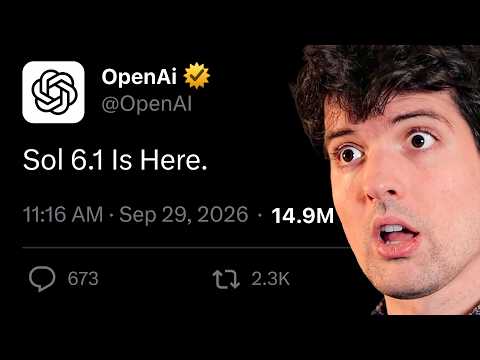
OpenAI fights back

Video thumbnail: OpenAI fights back
Sep 29, 202630m 59s video lengthTheo - t3․gg

The Signal

OpenAI has released GPT 6.1 Soul, a high-performance model that undercuts competitors on price and drastically improves reliability for automated workflows. While the model excels at scoped code audits and investigative tasks, it remains a secondary choice for heavy implementation, with Anthropic's Opus 5.5 retaining its edge for complex, long-running codebase rewrites.

The Case

Capability and Trust

  • GPT 6.1 Soul is markedly less "spiky" and erratic than GPT6 Astra, earning enough trust that the speaker now uses it for sensitive financial workflows like investment emails and invoice processing.11:29
  • The model is a standout for code review, root-cause investigation, and bug hunting, frequently identifying regressions that competitors—including Opus and Fable—entirely missed.13:08
  • Despite its coding prowess, Soul is visually competent but functionally poor at frontend design, with demos showing cluttered, janky UI that indicates a lack of stylistic taste.22:20

Economics and Performance

  • The release introduces a aggressive pricing structure: $2 per million input tokens, $10 for output, and a critical $0.10 for cached input tokens.7:10
  • Because agent-based workflows consist of nearly 96% cache reads, this pricing shift effectively slashes the cost of automation, making Soul a viable default for scoped agentic work.7:45
  • Terminal Bench and Deep SWE benchmarks show Soul matching or exceeding stronger models at a fraction of the cost, though the speaker maintains that benchmarks remain an imperfect proxy for real-world reliability.4:15

The Hierarchy of Models

  • Anthropic's Opus 5.5 remains the superior choice for unattended, multi-month refactoring projects, where it successfully completed a TypeScript-to-Rust port that other models failed to resolve after months of effort.15:53
  • Soul has largely displaced Sonnet in the speaker’s stack for routine coding tasks, but will function primarily as a tandem partner to Opus, handling analysis and triage while leaving implementation to the more capable frontier model.27:51

The 1 Minute Signal Take

GPT 6.1 Soul is a pragmatic upgrade for developers needing high-frequency code auditing and cost-efficient agentic throughput. It does not render current frontier models obsolete, but it forces a move toward hybrid stacks: utilize Soul for the analytical heavy lifting and keep Opus for the complex, creative implementation.

Pro Analysis

Why It Matters

GPT 6.1 Soul represents a pivotal shift from chasing raw model 'intelligence' to focusing on the economics of utility. By aggressively discounting cached tokens, OpenAI is effectively incentivizing developers to build deeper, more iterative agentic loops, fundamentally changing the cost-benefit analysis of using LLMs for background automation.

Strategic Implications

The model cements a 'specialist' paradigm in AI development. Developers are moving away from a singular 'do-it-all' model toward a tiered stack where specialized models handle review, triage, and implementation independently. This puts pressure on Anthropic and other competitors to not only match capability but to replicate this specific economic efficiency.

Evidence & Hype Audit

The content relies heavily on personal anecdote and workflow comparison rather than verified, third-party benchmarks. While the speaker's transparency regarding his workflow is refreshing, the claims about the model's superiority in debugging should be viewed through the lens of one developer’s specific stack. The dismissal of 'Jev Router' as a 'bad idea' is compelling but remains a subjective critique.

Counterarguments

A contrarian view would argue that relying on multiple models for a single codebase—a 'tandem' approach—introduces unnecessary cognitive and architectural load. Critics might also suggest that the lower pricing is a short-term acquisition strategy rather than a sustainable shift in margin structure.

Role-Specific Takeaways

  • Engineering Leads: Evaluate whether integrating GPT 6.1 Soul into your PR review pipeline can reduce the manual burden on senior staff.
  • Infrastructure Teams: Assess if the sponsor’s bare-metal CI offerings (Depot) align with your current feedback-loop requirements.

What to Do Next

  • Conduct a blind test comparing your current review model's bug-detection rate against Soul.
  • Re-evaluate your monthly cloud spend based on the new cached-token pricing model.
  • Explicitly forbid the use of AI for frontend design until high-fidelity style agents evolve.
  • Benchmark your current CI wall-times against bare-metal alternatives to identify potential friction points.
Time saved:27m 35s

Share this

Tags

Written by: 1 Minute Signal Editorial Team