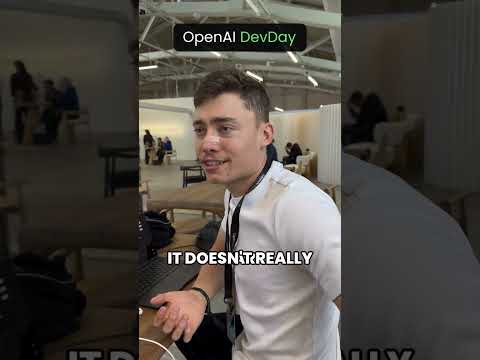
David's takes on OpenAI DevDay

Video thumbnail: David's takes on OpenAI DevDay
Sep 29, 20262m 10s video lengthDavid Ondrej

The Signal

OpenAI’s recent developer event landed as a mixed, largely consumer-oriented product update that left core technical users dissatisfied. The primary tension lies between OpenAI’s push for integrated enterprise ecosystems and the developer community’s demand for transparent performance benchmarks, with the speaker characterizing the closed-platform strategy as a recurring, startup-fueling cycle.

The Case

  • The event focused heavily on enterprise and consumer packaging, missing the technical breakthroughs developers expected while suffering from two high-profile, failed live demos.
  • Speaker David, a developer attendee, views the lack of comparative benchmarks for the new decision API as a warning sign that the model may be inferior or significantly more expensive than existing alternatives.0:17
  • The rapid release of GBD Soul 6.1 just three days after GBD6 soul is viewed as suspiciously reactive, potentially spurred by competitive pressure from Anthropic, a competing AI research lab.
  • While most announcements were dismissed as non-impactful, the speaker identified "Spaces"—a document-based collaboration environment for AI agents—as the only release with genuine potential for agent-to-workflow integration.1:10
  • The cloud-related release was criticized for being closed-source and restricted to GPT models, leading the speaker to argue that such incumbent lock-in strategies inevitably create market openings for independent startups.1:32

The 1 Minute Signal Take

The takeaway is a growing divergence between platform providers building walled enterprise ecosystems and developers seeking granular technical control and transparency. Unless OpenAI provides concrete benchmarking to substantiate its product claims, the company risks losing developer trust to more open or performance-transparent competitors.

Pro Analysis

Why it matters

This reaction serves as a microcosm of the growing tension between AI labs attempting to commoditize their models through vertical integration and the developer community that values modularity and transparent performance metrics.

Strategic Implications

OpenAI is clearly pivoting toward becoming a product-led organization, prioritizing seamless user experiences over the raw, hackable primitives that early adopters crave. For startups, this creates a 'platform risk' where the core functionality can be obsoleted by a first-party feature release, yet simultaneously creates 'market openings' for tools that interoperate across restricted silos.

Evidence & Hype Audit

The content is largely high-inference and subjective. While the observations regarding the event's content (e.g., failed demos, missing benchmarks) are factual, the conclusions drawn—specifically regarding motive and product quality—are speculative and should be treated as opinion rather than data-backed analysis.

Counterarguments

Critics of this perspective might argue that OpenAI is successfully democratizing AI for non-technical enterprise users, which is a larger, more sustainable market than the niche group of developers who demand transparent, open-source-adjacent tooling.

Who should care

  • Enterprise Architects: Must weigh the risks of moving into a proprietary, model-locked ecosystem.
  • AI Startup Founders: Should look for the 'gaps' left by closed, consumer-heavy product roadmaps.
  • Platform Researchers: Need to track the divergence between developer-first and consumer-first AI strategies.

What to do next

  • Audit existing dependencies on GPT-specific APIs.
  • Evaluate 'Spaces' to see if it replaces existing collaborative document workflows.
  • Track competitor responses to these releases to verify if the 'reactive cadence' theory holds.
  • Pressure providers for transparent performance benchmarking in future API releases.

Share this

Tags

Written by: 1 Minute Signal Editorial Team