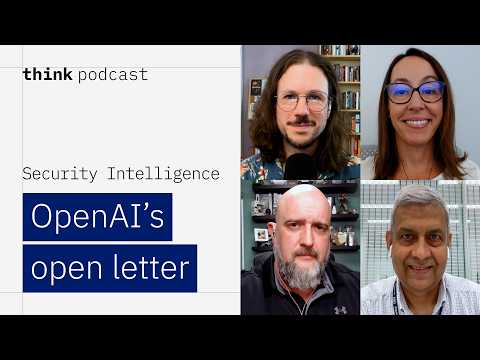
Why OpenAI is calling for a ‘cyber defense surge.’ Plus: Find Evil! winners and TeamPCP losers

Video thumbnail: Why OpenAI is calling for a ‘cyber defense surge.’ Plus: Find Evil! winners and TeamPCP losers
Sep 2, 202629m 9s video lengthIBM Technology

The Signal

Cyber defense leaders are pivoting from sharing raw threat intelligence to distributing actionable remediation strategies, arguing that 'time to remediation' is the new industry benchmark. While advocating for an urgent collective surge in defensive AI capabilities, the panel insists that humans must retain authority over high-consequence response actions to mitigate risks like hallucination.

The Case

Collective defense and remediation

  • IBM, OpenAI, and ~100 other organizations are calling for a global surge in cyber defense, urging entities to prioritize security as a core business operation rather than an afterthought.0:01
  • Industry experts define this shift as a move toward sharing tested playbooks, patches, and remediation strategies—rather than just alerts—to ensure defenders no longer learn only after suffering an attack.3:01
  • Panelists caution that collective defense may remain inequitable, as smaller municipalities, hospitals, and water systems lack the maturity to implement advanced defensive tools as quickly as large banks or tech firms.11:40

Autonomy and human-in-the-loop

  • The SANS Institute’s 'Find Evil' hackathon revealed that autonomous agents are becoming highly credible at forensic investigation, provided they employ 'self-questioning' mechanisms that force the agent to validate its own internal consistency.14:01
  • Despite progress in investigation, experts draw a sharp line at response actions; humans must remain in the loop for high-stakes tasks like shutting down servers, revoking identities, or changing firewall policies to avoid unpredictable blast-radius damage.15:48
  • AI is framed as an augmentation tool that accelerates analysis and report drafting, not a replacement for human experts, as systems can still hallucinate even when programmed to self-check.17:53

Attacker operational failures

  • The recent identification and arrest of alleged Team PCP leaders—a group linked to the LightLM backdoor—demonstrated that even sophisticated threat actors are prone to mundane operational sloppiness.23:12
  • Investigators unmasked the group largely because of poor credential hygiene, specifically the reuse of the 'dead Cat X3' handle and identical passwords across multiple platforms, including a personal Steam gaming account.22:35

The 1 Minute Signal Take

The industry’s shift toward shared remediation playbooks and self-questioning investigative agents represents a mature step toward standardizing defense. However, the reliance on human oversight for response actions remains the critical safeguard against the risks of automation, especially as attackers continue to be exposed by basic failures in their own operational security.

Pro Analysis

Why It Matters

The transition from threat intelligence sharing to remediation sharing is a fundamental evolution in cyber defense. Historically, we have been obsessed with 'who is attacking'; the focus now is shifting to 'how do we stop them from succeeding in under an hour.'

Strategic Implications

Organizations that fail to adopt this 'collective defense' mindset risk becoming isolated targets. The emphasis on open-source, self-checking agents suggests that the future of defense is not just proprietary black-box tools, but collaborative, auditable workflows.

Evidence & Hype Audit

The content relies on a mix of expert interpretation and industry-led initiatives. While the call for a 'surge' has an element of PR, the underlying mechanics—the need for faster patching and human-in-the-loop controls—are rooted in well-understood operational security principles.

Counterarguments

Critics might argue that sharing remediation strategies risks alerting attackers to how they are being hunted, effectively teaching them how to improve their own operational security (OpSec) faster than the industry can patch.

Who Should Care

  • CISOs: Need to rethink their team's reliance on alerts vs. automated remediation.
  • Infrastructure Operators: Must prioritize 'low-maturity' sectors like municipalities.
  • Security Researchers: Should look toward building self-skeptical forensic agents.

What To Do Next

  • Implement a 'human-in-the-loop' gate for all network-wide policy changes.
  • Audit all internal service accounts for credential reuse.
  • Evaluate your organization's 'time-to-remediate' metric for known vulnerabilities.
  • Participate in collaborative threat-sharing forums that focus on playbooks, not just IoCs (Indicators of Compromise).
Time saved:25m 59s

Share this

Tags

Written by: 1 Minute Signal Editorial Team