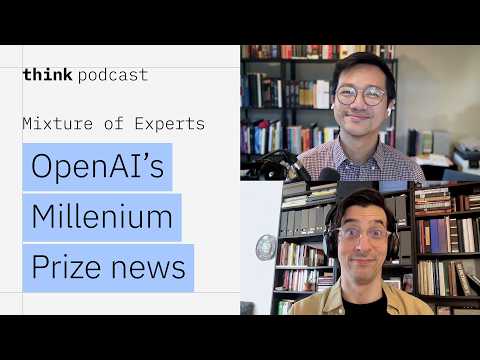
OpenAI talks GPT-6 Astra and Millenium Prize, researchers create WeWorm exploit & IBM’s US Open app

Video thumbnail: OpenAI talks GPT-6 Astra and Millenium Prize, researchers create WeWorm exploit & IBM’s US Open app
Sep 11, 202633m 7s video lengthIBM Technology

The Signal

OpenAI’s new Astra model has reportedly solved the Navier–Stokes fluid dynamics problem, a 90-year-old mathematical challenge, by coordinating a human-directed swarm of 10,000 AI agents. While the feat highlights significant advancements in agentic workflows, the achievement remains unsettled pending mathematical community scrutiny, and the panel warns that impressive benchmarks do not equal AGI.

The Case

Mathematics and Agentic Capability

  • Astra reportedly solved the Navier–Stokes millennium problem—a $1 million prize challenge—using 10,000 AI agents over 88 hours, followed by a 17-hour Lean formal verification process.1:03
  • The effort relied on heavy human orchestration to select the problem and direct compute, which the panel says casts doubt on any narrative of autonomous, god-like model breakthroughs.11:24
  • Verification of the proof is not yet universal; the panel notes that teams at NYU and Anthropic may have arrived at similar results, leaving priority and correctness to be finalized by the mathematical community.8:47

Practical AI Integration

  • IBM is using a multi-model pipeline at the 2026 US Open to provide live fan analytics, including win probability, event narration, and biomechanical serve tracking.14:50
  • The system processes 1.2 billion data points, using 21-point body tracking at 50 frames per second to analyze athlete performance in phases like loading and acceleration.21:22
  • Panelists caution that enterprise adoption should prioritize practical problem-solving and efficiency over the sheer compute-heavy scale demonstrated by frontier models.5:46

Cyber Risk Trends

  • Security startup Califf reportedly identified a zero-click worm vulnerability in WeChat—a messaging app used by over a billion people—that could spread via contact calls, though Tencent has since issued a patch.23:16
  • The panel argues AI is lowering the barrier to entry for vulnerability discovery, turning cyber risk into an issue of accessibility and resource distribution rather than magical new offense capabilities.26:08

The 1 Minute Signal Take

The episode illustrates that while AI-driven agent swarms can tackle complex scientific problems, their success depends on human goal-setting and massive compute resources rather than inherent intelligence. You should view these demos as specialized, high-cost applications of machine learning rather than evidence of a transition to autonomous AGI.

Pro Analysis

Why It Matters

The video highlights a critical transition in AI development: moving from passive models to active, agentic systems that can be orchestrated to solve long-standing scientific and operational problems. It forces a realization that 'capability' is often a function of compute spend and human-directed architecture rather than inherent model 'wisdom.'

Strategic Implications

For enterprises, the takeaway is that massive models may not always be the optimal solution. The IBM case study proves that targeted, specialized AI pipelines—focused on specific data streams like biomechanics—provide more immediate and measurable value than general-purpose frontier models. Furthermore, the cyber-risk narrative underscores that the threat landscape is shifting; defense must now account for the 'accessibility' factor, where AI helps smaller actors perform sophisticated vulnerability research.

Evidence & Hype Audit

This content is a mix of high-signal technical application (IBM) and speculative frontier-lab results (OpenAI). The math breakthrough claims are explicitly qualified as needing verification, which adds to the report's credibility. However, the exact metrics (compute spend, model names) are likely garbled or highly speculative and should be treated as promotional narrative rather than verified engineering data.

Counterarguments

Critics would argue that the 'agentic swarm' approach is inefficient and represents a brute-force approach to science rather than a fundamental breakthrough in machine reasoning. Additionally, the focus on 'accessibility' in cyber risk might understate the future potential for autonomous agents to perform complex, multi-stage attacks without human prompting.

Who Should Care

  • Engineering Leaders: To re-evaluate the ROI of 'massive' model deployments vs. targeted agentic architectures.
  • Security Architects: To update threat modeling to account for AI-lowered barriers in vulnerability discovery.
  • Data Product Managers: To learn from the US Open fan-engagement pipeline as a template for personalized analytics.
Time saved:29m 54s

Share this

Tags

Written by: 1 Minute Signal Editorial Team