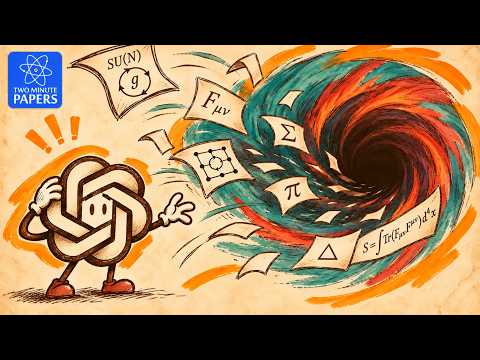
OpenAI's New Breakthrough Is... Utter Chaos

Video thumbnail: OpenAI's New Breakthrough Is... Utter Chaos
Nov 17, 20266m 14s video lengthTwo Minute Papers

The Signal

A researcher reports that an OpenAI AI system has produced a candidate formal proof for the existence component of the Yang–Mills problem, a million-dollar Millennium Prize challenge. While the proof reportedly passed automated Lean verification, human review is ongoing and the mass-gap component remains unsolved, leaving the result's ultimate validity and theorem correspondence contested.

The Case

Mathematical Context

  • The Yang–Mills existence problem asks whether a quantum theory of the strong nuclear force remains mathematically meaningful as spacetime grids are made arbitrarily fine.0:35
  • Increasing grid density normally complicates the analysis because quantum fluctuations intensify, and finer-scale interactions can cause mathematical behavior to spiral out of control.1:58

The AI-Generated Proof

  • The AI system reportedly builds on Balaban’s approach by simultaneously tracking multiple grid scales, calculating how fine-scale fluctuations impact coarser approximations to maintain stability.2:50
  • The presenter notes the output is a "proposed solution" rather than a settled one, as the AI system may have proved a result that does not perfectly map to the intended theorem.5:20
  • The proof codebase is described as containing approximately 250,000 declarations, 60% of which are reportedly unnecessary, creating a massive "spaghetti" codebase that is difficult for human experts to audit.4:17

Review Status

  • A review group led by Nobel Prize-winning physicist David Gross is currently evaluating the proof; the presenter describes initial results as encouraging but stresses that the process is unfinished.3:51
  • The presenter maintains that while Lean checking confirms the code is internally logical, it does not confirm the proof addresses the original Millennium problem accurately.

Commercial Promotion

  • The video includes a promotional segment for Lambda, a cloud services company providing NVIDIA GPUs, which the presenter claims is useful for rapid AI experiment reproduction.

The 1 Minute Signal Take

This is a report of a potential, unverified breakthrough that requires significant caution. The critical takeaway is that formal verification by an AI—even if technically correct—does not equate to a solved Millennium problem, especially when the code is largely opaque to human auditors.

Pro Analysis

Why It Matters

This case represents a fundamental shift in scientific discovery, where AI acts as a brute-force heuristic tool for symbolic mathematics. If valid, it provides a template for solving other Millennium-class problems. If it fails, it highlights the 'black box' problem in automated reasoning, where the machine produces the correct output for the wrong formal definition.

Strategic Implications

The reliance on multiscale tracking as a 'silver bullet' for continuum limits implies that future AI research in physics will pivot toward automated formalization. However, the 'spaghetti' nature of the codebase suggests that we are entering an era of 'computational debt' in mathematics, where the cost of verification may eventually outstrip the utility of the original discovery.

Evidence & Hype Audit

The content is high-hype and low-evidence. It relies on the presenter's anecdotal reporting of a peer-review process that is currently in-progress. No raw data, Lean proof snapshots, or independent whitepapers were provided to substantiate the 250,000-declaration claim or the success of the multiscale method.

Counterarguments

A contrarian view would argue that the 'spaghetti' code and unused declarations are irrelevant if the proof holds under Lean. In formal logic, the proof is either valid or invalid; the presence of extra definitions is a subjective aesthetic critique rather than a functional one.

Who Should Care

  • Math Researchers: To monitor the development of formal verification methodologies.
  • AI Ethics & Audit Specialists: To study the risks of AI-generated proofs that are too dense for human comprehension.
  • Physics Practitioners: To stay updated on the status of the strong force theory and Millennium problems.

What to Do Next

  • Monitor public updates from the review group led by David Gross.
  • Investigate the specific formal definitions used in the Lean proof to ensure they map correctly to Yang–Mills axioms.
  • Evaluate the feasibility of using LLMs to simplify and prune 'spaghetti' code in formal mathematical proofs.
  • Track the distinction between 'existence' results and 'mass-gap' requirements in future AI-mathematical releases.
Time saved:2m 50s

Share this

Tags

Written by: 1 Minute Signal Editorial Team