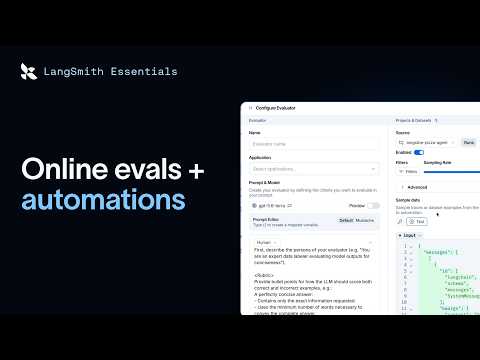
Online Evals and Automations | Introduction to LangSmith (7/12)

Video thumbnail: Online Evals and Automations | Introduction to LangSmith (7/12)
Nov 17, 20267m 35s video lengthLangChain

The Signal

This tutorial outlines a workflow for monitoring customer sentiment in live AI agent conversations using LangSmith, an observability tool. By transitioning from reactive, staff-reported feedback to proactive, automated sentiment analysis, teams aim to identify unhappy customers in real time. The reliability of these automated judgments remains unverified, as the system currently flags threads without explaining why customers are dissatisfied.

The Case

Monitoring Shift

  • The workflow replaces a delayed process—where staff reported issues after orders were finished—with an online sentiment evaluator that processes conversation data as it arrives.0:40
  • The setup relies on a thread-level sentiment judge that calculates scores based on human-AI message pairs, configured to ignore non-conversational tool calls.4:34
  • To ensure timely detection, the evaluator triggers after a two-minute idle period on a thread, rather than operating strictly instantaneously.5:17

Evaluation and Triage

  • Developers can deploy pre-tuned judges like "Perceived Error," which flags contradictions or customer corrections, or build custom sentiment evaluators that return a binary score.2:26
  • All scored threads—both positive and negative—are routed to a "Sentiment Triage" queue for human annotation, allowing the team to calibrate the evaluator's accuracy against human judgment.6:22
  • In the demonstration, the system flagged some threads as negative, even though they completed without technical execution errors; the narrator notes that these cases require manual investigation to identify the source of user frustration.7:17

The 1 Minute Signal Take

This approach highlights the trade-off between automating feedback loops and maintaining signal quality, as an automated flag merely signals that a conversation deserves attention rather than explaining the root cause. Without independent validation of the judge’s accuracy, the system currently functions as a prioritization tool for human auditors rather than an automated resolution engine.

Pro Analysis

Why it matters

Monitoring AI agents in production is significantly harder than testing them in isolation. This content provides a blueprint for 'online evaluation,' moving the needle from subjective anecdotal reports of agent performance to objective, event-driven sentiment tracking.

Strategic implications

By automating the triage of conversations, organizations move from a reactive model (fixing bugs after complaints) to an observatory model (identifying friction points in real-time). This reduces the 'time-to-resolution' for issues that do not trigger hard technical errors but do damage user experience.

Evidence & Hype Audit

This is a feature-focused instructional demo. While it offers high utility for users of the platform, it makes several high-level claims about the efficacy of 'pre-tuned' evaluators like 'Perceived Error' that lack transparent benchmarks. It is best treated as a configuration guide rather than a proven scientific framework for sentiment analysis.

Counterarguments

Critics might argue that sentiment analysis is notoriously noisy. Relying on an LLM-as-a-judge to detect dissatisfaction may introduce significant false positives, leading to 'alert fatigue' where human reviewers ignore the triage queue entirely because the signals are too vague.

Who should care

  • Product Engineers: For setting up automated quality gates.
  • Support Leads: For prioritizing which tickets require immediate human intervention.
  • MLOps Practitioners: For building robust observability pipelines around LLM agents.

What to do next

  • Audit the rubric used in your sentiment evaluator to ensure it aligns with your specific product definitions of 'negative' and 'positive'.
  • Implement a baseline manual review of the first 50 flagged threads to confirm the judge's accuracy before expanding scope.
  • Configure your thread-idle timers based on the average length of your specific agent-customer interactions.
  • Set up automated alerts for your 'Sentiment Triage' queue to ensure timely human intervention.
  • Periodically sample 'positive' threads to check for false negatives (missed complaints).
Time saved:4m 36s

Share this

Tags

Written by: 1 Minute Signal Editorial Team