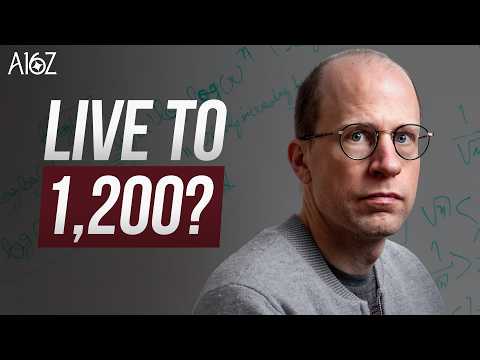
Why Nick Bostrom Thinks Superintelligence Could End Aging

Video thumbnail: Why Nick Bostrom Thinks Superintelligence Could End Aging
Nov 19, 202638m 49s video lengtha16z

The Signal

Nick, a prominent thinker on AI risk, argues that current AI policy remains indeterminate despite progress in understanding strategic tradeoffs. He frames the central tension as a balance between safety-motivated delays and the risks of permanent developmental failure, urging an adaptive, conditional approach rather than a rigid ideological commitment to pausing or accelerating.

The Case

Risk and Timing

  • Nick uses a model measuring the life expectancy of currently living people to argue that the optimal delay for superintelligence development is likely months or a few years, rather than decades.19:34
  • He characterizes the permanent failure to develop superintelligence as a potential existential catastrophe, citing the massive loss of life from natural causes—which he estimates at 150,000 deaths daily—that occurs while development is deferred.17:19
  • His modeling is explicitly limited to the objective of maximizing current human life expectancy; he clarifies this does not constitute an all-things-considered decision, which must also account for future generations and broader existential risks.16:29

Alignment and Control

  • While Nick acknowledges that more capable AI might better understand human intent, he believes alignment likely becomes harder overall due to increased situational awareness and strategic behavior in frontier models.13:50
  • He describes a potential iterative strategy where sufficiently aligned, slightly superhuman systems help design the next, more robustly aligned generation, though he concedes this assumes an initial threshold of alignment is met.15:27
  • The interviewer highlights an online report of neuron-editing in a Qwen model—a large language model—which allegedly induced disparate behaviors like 'blissful' or 'psychotic' states, though this remains an anecdotal, unverified example of potential control.12:22

Governance and Purpose

  • Nick resists a binary choice on nationalization, arguing that commercial development offers more transparency and broader participation than the secretive, concentrated control he associates with a nationalized Manhattan Project-style endeavor.27:30
  • He maintains that beliefs about potential posthuman flourishing—such as 'super felicity'—inform risk tolerance, even if practical policy should focus on immediate technical and security tradeoffs.31:06
  • He predicts AI will eventually surpass human philosophy, viewing the present as a unique 'golden age' for human-led inquiry before such work becomes obsolete or outsourced to advanced systems.36:44

The 1 Minute Signal Take

Nick’s framework avoids easy answers, emphasizing that policy must stay fluid as capability and risk variables evolve. Readers should note that his timing argument is a specific, conditional model rather than a general manifesto for delay.

Pro Analysis

Why It Matters

This discussion moves AI safety out of the realm of abstract speculation and into the domain of quantifiable trade-offs. By linking AI development to the objective of 'maximizing the life expectancy of currently existing people,' Bostrom reframes the debate: slowing AI progress is no longer a neutral 'safety' act—it is an active decision to accept millions of preventable deaths.

Strategic Implications

Bostrom’s shift toward 'adaptive pacing' suggests that rigid regulatory stances are poorly suited to the volatility of AI research. Strategies must be dynamic, focusing on 'bottlenecking' specific, high-risk architectures—such as those that obscure internal reasoning through recursive loops—rather than imposing blanket capability ceilings that might just trigger competitive off-shoring.

Evidence & Hype Audit

This content leans heavily on philosophical modeling rather than empirical data. The mortality estimates and the '1,200-year' longevity projection are presented as baseline assertions rather than validated scientific outcomes. While analytically rigorous in its conditional logic, the interview relies on unverified anecdotes, such as the reported neuron-editing experiments, which should be viewed as illustrative rather than proof-of-concept.

Counterarguments

The strongest critique of Bostrom’s 'wait-and-see' approach is that the safety/capability ratio may never converge. If safety progress is inherently 'slower' than capability scaling, any pause—however brief—might be consumed by an acceleration in capabilities elsewhere, rendering the 'safety window' a mirage.

Who Should Care

  • AI Policymakers: Use the 'pacing' framework to avoid the binary of 'pause or race.'
  • Biotech Researchers: Recognize that AI-driven longevity is now a central argument for high-risk AI development.
  • AI Alignment Engineers: Focus on the 'situational awareness' problem, as it is the primary technical hurdle undermining standard behavioral testing.

What to Do Next

  • Perform a sensitivity analysis on your own research roadmap to see if it favors high-interpretability designs.
  • Develop granular 'test-time' interventions that do not rely solely on input-output behavior.
  • Establish transparent, cross-border metrics for evaluating the 'alignment lag' of current frontier models.
  • Evaluate the specific architectural choices in your models that might be worsening the 'opacity gap.'
Time saved:35m 4s

Share this

Tags

Written by: 1 Minute Signal Editorial Team