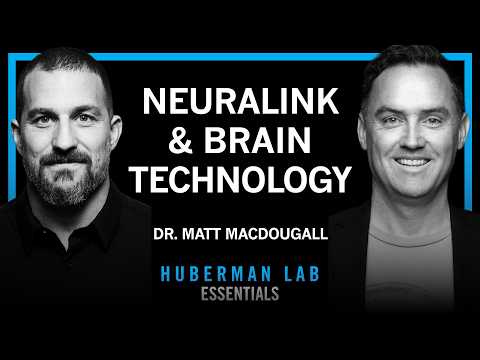
Essentials: Neuralink & Technologies to Enhance Human Brains | Dr. Matt MacDougall

Video thumbnail: Essentials: Neuralink & Technologies to Enhance Human Brains | Dr. Matt MacDougall
Oct 15, 202630m 18s video lengthAndrew Huberman

The Signal

Neuralink aims to restore digital agency to patients with severe paralysis by translating motor intentions into cursor and keyboard control. While the technology holds potential for long-term cognitive augmentation and neural restoration, the current focus is narrowly medical; robotics are required for the procedure because human manual placement lacks the necessary surgical precision.

The Case

Clinical Roadmap

  • Neuralink’s primary near-term mission is restoring computer control for individuals with severe spinal cord injuries, not immediate limb reconnection or human enhancement.6:05
  • Robotic insertion is a technical necessity, as the device electrodes are smaller than a human hair and must be placed with a level of precision and speed that human hands cannot match.7:07
  • The system utilizes a closed-loop learning process where both the software algorithms and the human user improve over time, allowing the brain to adapt to the interface.18:55

Ethics and Ambition

  • Dr. Matthew McDougall, a neurosurgeon affiliated with Neuralink, defends the company’s animal research as necessary for FDA safety validation, asserting that animals are never compelled to participate beyond their surgeries.21:30
  • McDougall describes the long-term vision as an expansion of human cognition into AI, suggesting that there is no fundamental barrier to eventually interfacing with millions of neurons to treat conditions like addiction or obesity.27:22
  • McDougall personally demonstrates his commitment to the technology by wearing a passive RFID implant in his hand, which serves as a proof-of-concept for internalizing device-based access control.13:26

The 1 Minute Signal Take

The immediate utility of Neuralink is limited to a specific medical niche, and the more expansive sci-fi claims regarding cognitive augmentation remain aspirational rather than demonstrated. You should view current performance data—especially monkey-based bit rates—as a proof of concept for medical restoration rather than evidence of a ready-to-use human enhancement platform.

Pro Analysis

Why It Matters

Neuralink represents the most prominent attempt to bridge the gap between human intent and digital execution. By focusing on the 'motor-intention bottleneck,' the project aims to solve the most pressing accessibility challenges for patients with total physical paralysis. If successful at scale, this technology could define the next era of neuro-prosthetics.

Strategic Implications

The reliance on robotic surgery shifts the bottleneck of neuro-interventions from 'surgeon skill' to 'hardware reliability.' This potentially democratizes neurosurgery if the procedure becomes sufficiently standardized, but it also creates a single point of failure in the proprietary robotic platform.

Evidence & Hype Audit

  • High Integrity: The core medical mission (mouse/keyboard control) is transparent and scientifically grounded in known BCI principles.
  • Hype Risk: Assertions about future 'thought-to-thought' communication or safety superiority are largely aspirational. The transcript lacks independent data or comparative clinical stats to validate these superlative claims.

Counterarguments

Critics argue that the focus on invasive implants ignores non-invasive BCI advancements that carry zero surgical risk. Furthermore, the long-term ethical implications of 'multi-brain' integration or AI-cognitive embedding are currently unaddressed in the development roadmap.

Who Should Care

  • Medical Tech Investors: Watch for FDA clinical trial results.
  • Bioethicists: Focus on the implications of long-term human augmentation.
  • Robotics Engineers: Note the specific demand for high-precision, automated surgical tasks.

What To Do Next

  • Review published FDA clinical trial disclosures for the Neuralink device.
  • Research current benchmarks for non-invasive (EEG-based) brain-computer interfaces to compare efficacy.
  • Track the development of biocompatible materials that extend the life of chronic neural implants.
  • Investigate the ethical frameworks proposed for potential future human augmentation devices.
Time saved:27m 24s

Share this

Written by: 1 Minute Signal Editorial Team