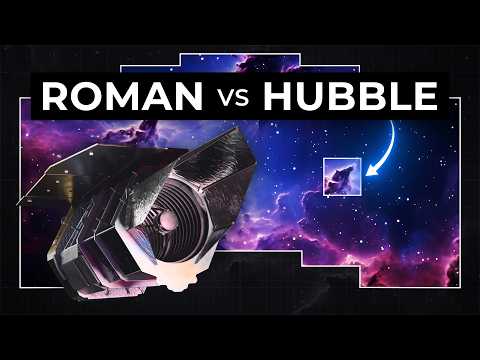
NASA’s Next Monster Telescope

Video thumbnail: NASA’s Next Monster Telescope
Aug 29, 202621m 51s video lengthReal Engineering

The Signal

The Nancy Grace Roman Space Telescope represents a shift from the deep, narrow-field study of the James Webb Space Telescope toward wide-area survey science. By leveraging heritage optics from a cancelled NRO spy-satellite program, the mission aims to map dark matter and conduct a massive exoplanet census, though its most ambitious discovery claims remain predictive estimates.

The Case

Telescope Design and Capability

  • The telescope features a 2.4-meter mirror—the same diameter as Hubble’s—but uses a wide-field optical path to image areas of the sky up to 100 times larger than Hubble at equivalent resolution.1:45
  • Its hardware originates from a donated, cancelled NRO spy-satellite program, significantly reducing costs while requiring modernization of the mirror’s silver-coated optics.
  • Operational stability is maintained via an L2 halo orbit, a location 1.5 million kilometers from Earth that provides the thermal consistency necessary for infrared survey work and fixed Sun-Earth-Moon geometry.18:22

Scientific Goals and Projections

  • Roman will identify dark matter by measuring minute gravitational lensing distortions across hundreds of millions of galaxies, relying on the Bullet Cluster and galaxy rotation as established evidence for dark matter’s influence.9:06
  • The mission is expected to find between 60,000 and 200,000 new exoplanets over five years through microlensing, which allows for the detection of planets and free-floating rogue worlds across the galaxy.10:44
  • A high-contrast coronagraph will serve as a technology demonstration for future observatories, using thousands of piezoelectric actuators to suppress starlight 20 times per second to facilitate direct imaging and atmospheric spectroscopy.13:53

The 1 Minute Signal Take

Roman’s success hinges less on aperture size than on its capacity to process vast data volumes—projected at 20,000 terabytes—that will require sophisticated, public-access analytical workflows to turn raw images into astronomical discoveries. The mission promises to define the next era of cosmic surveying, provided it achieves the launch precision required to maximize its limited propellant budget for long-term station keeping at L2.

Pro Analysis

Why It Matters

The Roman Space Telescope represents a paradigm shift from 'boutique' science—where observatories target specific, high-interest objects—to 'survey' science, where the observatory treats the entire sky as an input signal to be processed. This is essential for understanding the distribution of dark matter and the true frequency of planetary formation.

Strategic Implications

By moving the burden of discovery from hardware sensitivity to data processing, NASA is effectively inviting the global research community to participate in citizen-science discovery. The reliance on SQL, Python, and API-based access suggests that future breakthroughs will be found by data analysts as much as by astrophysicists.

Evidence & Hype Audit

The content leans heavily on predictive modeling. While the hardware specifications are settled facts, the specific counts of rogue planets and exoplanets are projections. The 'revolution' narrative is strong, but actual impact is gated by the successful operation of the coronagraph and the processing of the massive, 20,000-terabyte dataset.

Counterarguments

Critics might argue that the complexity of the coronagraph system introduces a single point of failure for an instrument that is effectively a 'technology demo.' If the active optical correction (the 20 Hz piezoelectric cycle) fails, a major pillar of the mission's future-facing scientific value would be severely compromised.

Who Should Care

  • Astrophysicists: For the new gravitational lensing data and exoplanet counts.
  • Data Scientists: For the upcoming massive open-access datasets.
  • Mission Architects: For the L2 orbital station-keeping techniques.

What To Do Next

  • Monitor the upcoming launch schedule for the Falcon Heavy deployment.
  • Review the open-source data-analysis tools being developed for Roman’s datasets.
  • Study current microlensing survey methodologies to prepare for the massive influx of raw event data.
  • Track the progress of HWO (Habitable Worlds Observatory) to understand how Roman’s coronagraph findings will influence 2040-era designs.
Time saved:18m 41s

Share this

Tags

Written by: 1 Minute Signal Editorial Team