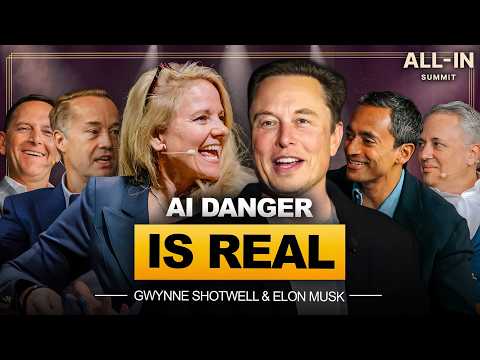
Elon Musk & Gwynne Shotwell on AI Risks and Peer Review, Starship, Terafab, SpaceX/Tesla Merger

Video thumbnail: Elon Musk & Gwynne Shotwell on AI Risks and Peer Review, Starship, Terafab, SpaceX/Tesla Merger
Sep 15, 20261h 4m 24s video lengthAll-In Podcast

The Signal

SpaceX has evolved from a scrappy R&D startup into a multi-vertical infrastructure giant spanning launch, satellite telecom, and now compute. The core tension lies in scaling this massive portfolio without succumbing to the bureaucratic friction that slows down competitors, while managing high-stakes geopolitical risks in chip manufacturing and AI development.

The Case

Operational Strategy

  • SpaceX succeeds by treating management as a friction-removal exercise rather than a process layer, aiming to let engineers spend ten hours a day on technical work rather than two.24:26
  • Company culture relies on the "player-coach" model where leaders actively manage execution, and the firm intentionally hires only those who have already achieved success elsewhere.22:38
  • While SpaceX, XAI, and X are not fully merged, integration of talent and leadership is accelerating as urgent needs arise across these related entities.9:31

The AI Safety Fix

  • Elon Musk proposes that instead of new government regulators, major AI labs should implement a peer-review system where competitors test each other’s models for deception and dangerous capabilities before release.29:55
  • This strategy is designed to be compatible with China's participation, as it avoids intrusive international bureaucracy while utilizing product liability laws as the primary enforcement mechanism.55:22

Growth and Resilience

  • SpaceX is pivoting from just rockets to becoming a compute-infrastructure provider, citing massive, steady demand for compute rental that shows no sign of slowing.12:43
  • The company’s new chip-manufacturing initiative, TerraFab, is a geopolitical hedge against Taiwan supply disruptions and an attempt to solve chronic industry-wide packaging bottlenecks.46:49
  • Starship is reaching an operational inflection point with upcoming flight tests aimed at refining tower catches, which the company expects to lead to rapid, aircraft-like reusability by 2027.42:42

Telecom and Expansion

  • SpaceX is vertically integrating its mobile strategy by moving away from leasing T-Mobile spectrum toward using its own acquired EchoStar holdings to eliminate U.S. cellular dead zones.14:23

The 1 Minute Signal Take

SpaceX is positioning itself as an essential compute and infrastructure utility, betting that its internal culture of ruthless friction-removal can sustain rapid scaling. The focus on cross-lab peer testing for AI suggests a preference for fast, industry-led governance over regulatory processes that might risk American competitive standing against China.

Pro Analysis

Why It Matters

SpaceX is attempting to vertically integrate the most critical bottlenecks of 21st-century civilization: energy, compute, chips, and transport. This is not just a company expansion; it is a fundamental bet that the current global industrial order is too fragile and slow to sustain the next wave of technological progress.

Strategic Implications

By pivoting into compute and chip manufacturing, SpaceX effectively hedges against both physical and geopolitical risks. If the company succeeds in becoming the world's primary provider of satellite-based compute and connectivity, it shifts from being a contractor for governments to being the essential substrate upon which global digital infrastructure sits. This confers immense leverage, as it moves the company into a position where it is almost impossible for national or international entities to regulate without undermining their own technical capabilities.

Evidence & Hype Audit

  • Execution Track Record: The company’s history of turning impossible engineering goals into operational reality (e.g., booster reusability) gives their claims a higher baseline of credibility than a typical corporate narrative.
  • Uncertainty: The AI peer-testing proposal is a brilliant strategic maneuver, but it remains a proposal. Whether major labs like Anthropic, OpenAI, or Google will actually sign on to expose their models to direct competitor audit is an open question, as it involves significant IP risks.
  • Operational Reality: The 'TerraFab' R&D effort is still in the 'crawl' phase. The claim that it could yield useful output by 2027 is ambitious given the complexity of fab build-outs.

Counterarguments

Critics might argue that Musk’s push for AI peer-testing is a way to force competitors to reveal their internal state, potentially allowing him to gain an advantage under the guise of safety. Furthermore, the extreme vertical integration could lead to a 'single point of failure' if the management culture—which relies on a very specific type of intense player-coach leadership—fails to scale past the original core team.

Who Should Care

  • Investors: Those tracking infrastructure-layer companies should watch the compute-rental business, as it currently has 'no drop in demand.'
  • Policy Makers: The peer-review model is a serious proposal for AI governance that avoids the common pitfalls of bureaucratic overreach.
  • Engineers: The focus on 'friction-stripping' is a masterclass in organizational design.

Next Steps

  • Observe how Starship flight 15 testing proceeds; the success of a 'catch' is the main variable.
  • Monitor any public adoption of cross-lab testing protocols.
  • Assess if other companies begin announcing similar R&D fab initiatives to combat semiconductor supply risks.
Time saved:1h 25s

Share this

Tags

Written by: 1 Minute Signal Editorial Team